

It’s not every day that you get to say “one quadrillion dollars” in a coherent sentence. Let’s try.
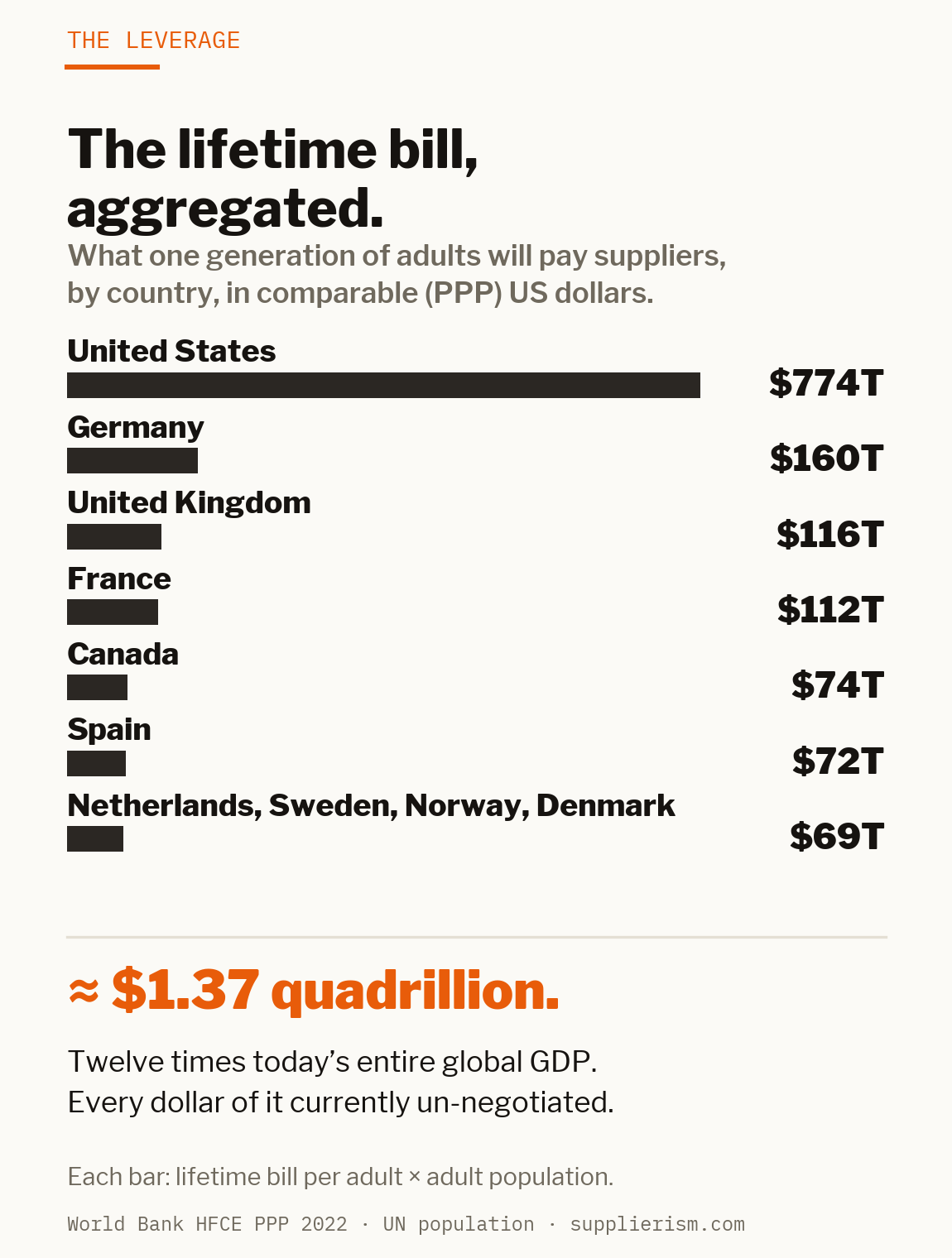
A quadrillion is a thousand trillions. Stacked in hundred-dollar bills, it would reach the moon two and a half times. The citizens of the ten countries shown below will spend well over one quadrillion dollars during their lifetimes.
How does that break down per person?
Over an adult lifetime, Canadians will spend an average of nearly $2.4 million on regular stuff. Americans, about $3 million each. Britons and continental Europeans, around $2 million each.
Not invested. Not saved. Money earned, then spent on ordinary things. On life. All of it handed over, day after day, to suppliers at the point of purchase. Here is where the money goes:
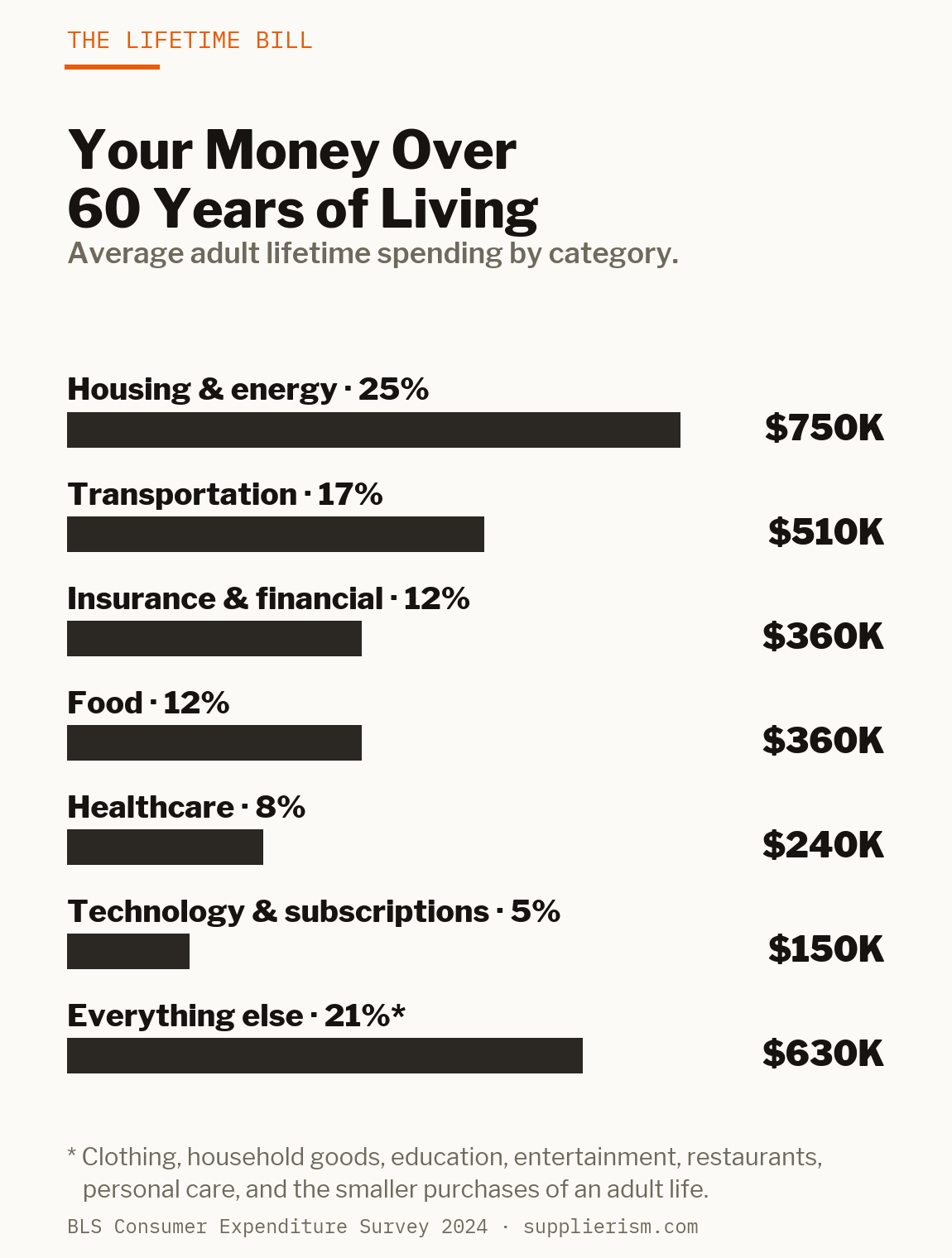
In general, every dollar is spent without any terms or conditions set by the buyer. That’s trillions a year of money handed to suppliers without the benefit of negotiations.
So what?
Could people get more value from the millions we each spend in a lifetime if we set terms and conditions with our suppliers?
We know the answer because corporations have been measuring it for decades. Bain studied more than a thousand large-scale procurement projects and found that structured buying adds 8 to 12 percent of value. Deloitte says the average company loses about 9 percent of contract value to poorly managed terms. McKinsey found that companies collaborating closely with suppliers grow faster and can reduce costs by 5 to 10 percent.
For professional buyers, contractual terms and conditions are an essential system for creating value. In business, you would be considered incompetent if you didn’t use them.
Professional buyers have a name for purchases made without terms and conditions. They call it maverick spending. Hackett Group found that maverick spending destroys up to 16 percent of the savings that organized procurement already won.
Serious buyers never purchase anything without making their suppliers sign agreements and guarantees before they hand over their money. There is always an enforcement mechanism that makes sure the contingent liabilities associated with a purchase sit with the supplier, and not with the buyer. (If you want to know why the world turns on the power of contingent liabilities, then read this).
As disorganized buyers, you and I lose money and raise our own costs when we don't copy what organized buyers do — when we don't set terms and conditions with our suppliers.
The reality of modern economics is that we all pay two bills for the things we purchase. The first is the price we pay at checkout. The second arrives years later, disguised as inflation, higher taxes, higher healthcare costs, and increased insurance premiums. These are the avoidable costs caused by climate damage, corruption, greed and incompetence. The second bill is directly related to the performance of your suppliers who sell you a lifetime of energy, transportation, food, technology, etc.
A supplier who leaves you with these hidden costs has low productivity. They hand you a second invisible invoice that takes your money, without asking.
Organized buyers already know this math. But we, regular people, are not very good at the part of capitalism that requires negotiations and contracts. This fact might be the single most important reason why the world has so many problems — and so many opportunities for positive change.
Here’s what I mean in numbers:
A sustained 1% improvement in supplier productivity is worth $25,000 to the average Western citizen the day it happens, and up to $620,000 over a compounding lifetime. Let’s be clear. That’s $620,000 that you and I are losing over a lifetime, and that’s another $620,000 for each of your children, and everyone living on your street, and so on.
Applied to the $1.37 quadrillion spent across just the ten countries in the chart above, that same sustained 1% improvement is worth $340 trillion.
That’s $5.67 trillion a year invested in making life safer, fairer, cleaner, freer — all without changing a single law, raising any new taxes, or asking anyone to change their politics or religion. All of it from copying a system in capitalism that already works.
One last note: the math applies to developing countries too. For example, India's billion-plus adults will spend about $570 trillion over their lifetimes (more than the UK, France and Germany combined), on virtually the same things as people living in the West (energy, transportation, food, technology, etc.). And like us, the majority of adults are already connected to their suppliers via a smartphone — the key technical catalyst for creating contracts with our suppliers.