

In July 1792, an architect named James Hoban won the competition to design the White House. President George Washington reviewed nine official entries, including one signed anonymously by Thomas Jefferson. But Hoban won and soon after construction started.
The stone for the White House came from Aquia Creek in Virginia. The US government bought the quarry in advance of construction. Enslaved men cut the stone and packed it in seashells for transport on barges upriver. Brick kilns were built beside the construction site. Irish immigrants dug and hauled materials. Axemen felled the floor and roof timbers in the forests of Maryland and Virginia. Masons dressed and laid the stone. The sawing, the brickmaking and most of the heavy labour was done by African American slaves.
The commissioners hired enslaved workers from the men who owned them, at twenty-one pounds a year, paid to the owner. The payrolls survive by first name only. Tom. Peter. Ben. Harry. Daniel. Four of those five were owned by James Hoban, the architect.
The total cost for the White House construction came to $232,372 across the eight years, all of it paid by Americans.
Fort York
A short walk from where I am writing this is Fort York. On April 27th, 1813, around seventeen hundred American troops came ashore west of the garrison. York was, at the time, the capital of Upper Canada. It would not be called Toronto for another twenty-one years.
The British commander, Roger Hale Sheaffe, read the situation and pulled his regulars out of Fort York. He left fuses burning in the grand magazine behind him, dug into the bluff at the water’s edge. It held some three hundred barrels of gunpowder along with every cartridge, round shot and shell the garrison had in reserve. The bluff channelled the blast outward, toward the Americans coming up from the Western Battery. Stone, beams and iron came down across five hundred yards. More than two hundred Americans were killed or wounded in a few seconds. Among them was Brigadier General Zebulon Pike.
Pike’s death is generally what historians point to as the moment the occupation escalated to another level of violence against Canada.
Over the days that followed, American troops burned the Parliament Buildings and Government House, a few kilometres east of the fort, near what is now Front and Parliament (a block from where I live today). They looted homes and the church, and destroyed the printing office. The Americans then carried off the ceremonial mace of the Legislative Assembly, which stayed in the United States until Franklin Roosevelt sent it back to Canada as a gesture of goodwill in 1934.
White House Ablaze
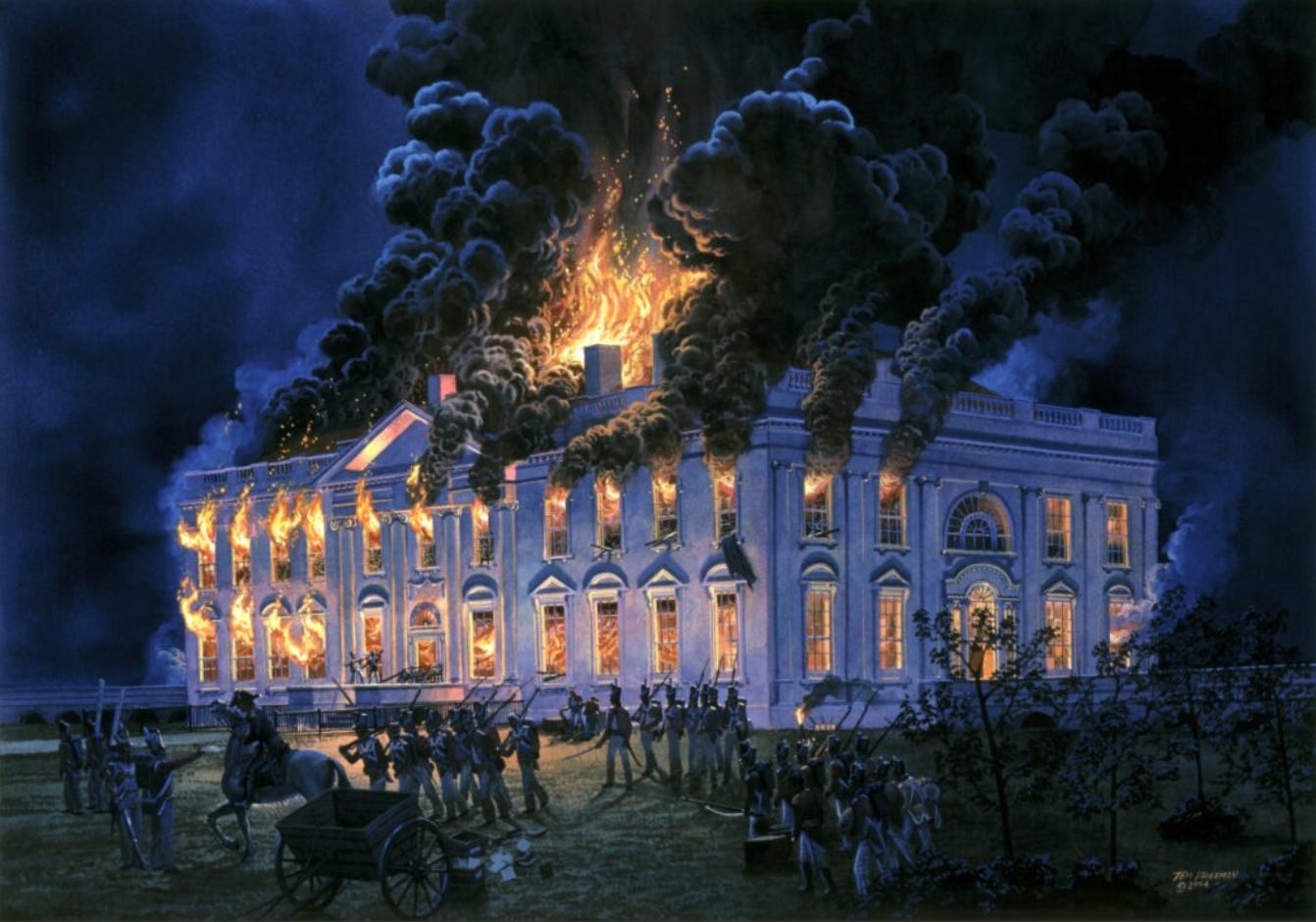
Sixteen months after the invasion of York, on August 24th, 1814, British troops set the White House in Washington on fire. York was the grievance they named.
In burning the White House, the British drew a distinction they were rather proud of: they destroyed public buildings and largely spared private ones, which they considered the more civilized way to do this sort of thing.
They were not all British regulars. Among them was the Second Corps of Colonial Marines, a unit raised in the spring of 1814 from American slaves who had escaped to British lines. They fought at Bladensburg on the way in, and companies of them are understood to have gone on into Washington.
A house built by enslaved Americans was burned, in part, by Americans who had freed themselves by reaching the other side.
Only the exterior walls of the White House survived.
Built again. And again.
Hoban was brought back to rebuild and restore the White House. Enslaved labour was hired again for the second build, on precisely the same terms as the first.
It cost $334,334.
James Monroe moved in on September 17th, 1817. Americans paid for every dollar.
In 1902, Theodore Roosevelt pushed the offices out into a new West Wing and made “the White House” the official name of the place. Between 1948 and 1952, Harry Truman had the entire interior torn out down to the exterior walls and a steel frame dropped in, because the building was failing. The leg of his daughter’s piano had gone through a floor, as proof.
The East Wing itself was a Roosevelt addition from 1942, put up partly to disguise the construction of the bunker underneath it.
Every previous version of the White House was paid for by an act of Congress.
Until Now
The East Wing came down in October 2025, to make room for a ninety-thousand-square-foot ballroom.
The project is now expected to cost over $400 million. The White House released a list of thirty-seven donors funding it. Twenty-one are corporations. You will recognize most of them:
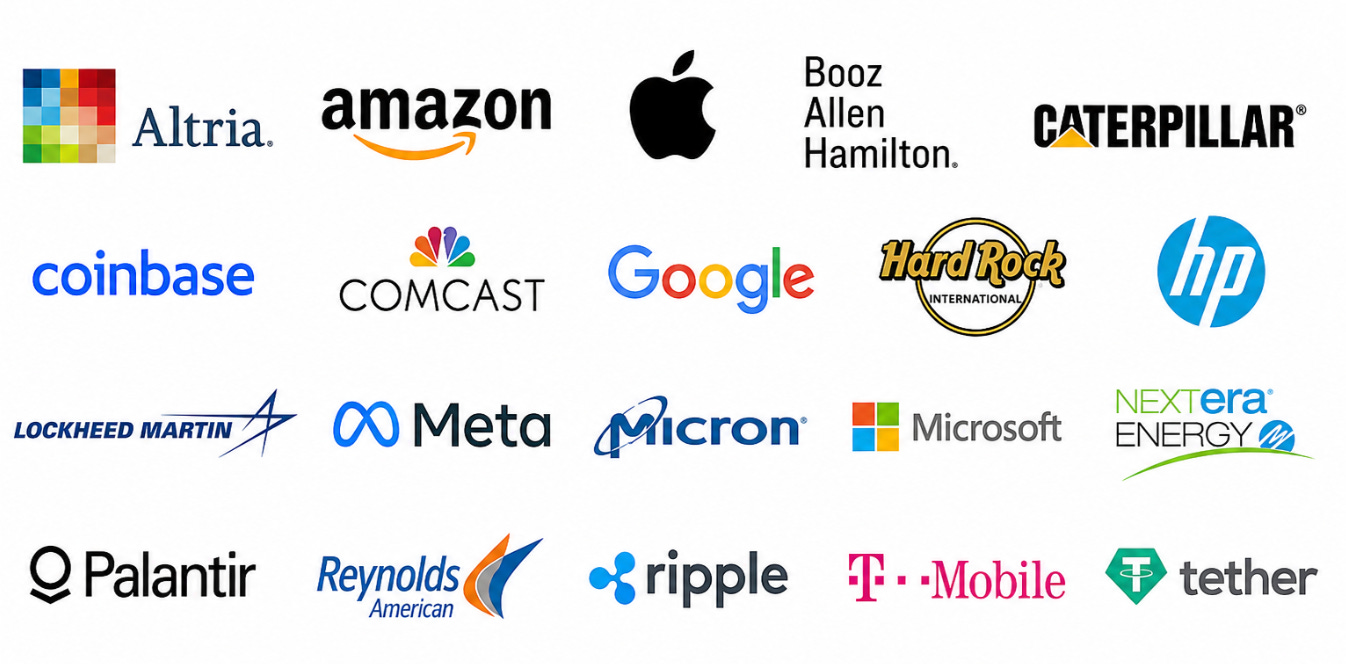
The companies funding President Trump's ballroom are almost certainly among your suppliers. (Please let me know if I’m wrong.)
If you carry a phone, it likely holds Micron memory and runs Apple or Google software. If you buy online, there is a good chance it went through Amazon. If you work in an office then you are probably using Microsoft products. If you watch anything in Britain or Ireland, then keep in mind that Comcast owns Sky. And, if you have searched for anything online, Google’s revenue from the advertiser who won that auction is downstream of you.
Corporate bank accounts are filled by their customers’ money. Our money. It gets transferred from our bank accounts to their accounts and, in this case, from there to President Trump’s White House bank account.
Follow your money far enough, and it ends up in that ballroom.
As last week’s post showed, the money we hand our suppliers runs to trillions a year, and quadrillions over a lifetime of buying.
Let’s trace how much of our money went from Google into the White House ballroom.
Google’s $22 million wasn’t even a simple donation. It was YouTube’s payment, earmarked for ballroom construction, made to settle the sitting president’s personal lawsuit over his suspended account. Customer money settled the litigation and built the ballroom in a single transaction.
Set $22 million against roughly $390 billion in annual revenue and it comes to 0.0056 percent. Set that against what Google earns from a typical Canadian or British adult in a year, and your personal contribution to the ballroom comes to a cent or two each, about $1.2 million of Canadian and British customer money in total.
But this is not about $1.2 million. It is about the blind permission we give our suppliers to take our money and spend it any way they wish, even when it offends us or contradicts our interests.
It is our fundamental interest that suppliers like Amazon, Apple, Google, Meta and Microsoft create value without sending us the second bill: the one that arrives years later as higher taxes, more conflict, a hotter planet and a childhood none of us chose for our kids.
It is therefore in our interest that our money be spent on creating valuable products and services, not on unpriced gifts to the government that regulates them. And yet Public Citizen found that more than half of the known corporate ballroom donors won new or expanded federal contracts worth over $50 billion in the six months that followed.
Through ballroom donations, I am paying my suppliers to support threats against my own country. At best, it is a very inefficient way to spend my money. At worst, it is a reasonable definition for ‘crazy’.
In 1813, the commander at Fort York answered with gunpowder. In 2026 the fuse is economic leverage, written as terms that force our suppliers to choose between their customers' money and political influence.
Until we set terms with our suppliers, our money will keep paying for more than a ballroom.