

Last month I turned on the TV to watch the Blue Jays game and got Samsung’s updated privacy terms instead. This made me angry. So I read the entire document.
Their new privacy terms run almost 4,600 words: more than four times the length of this article.
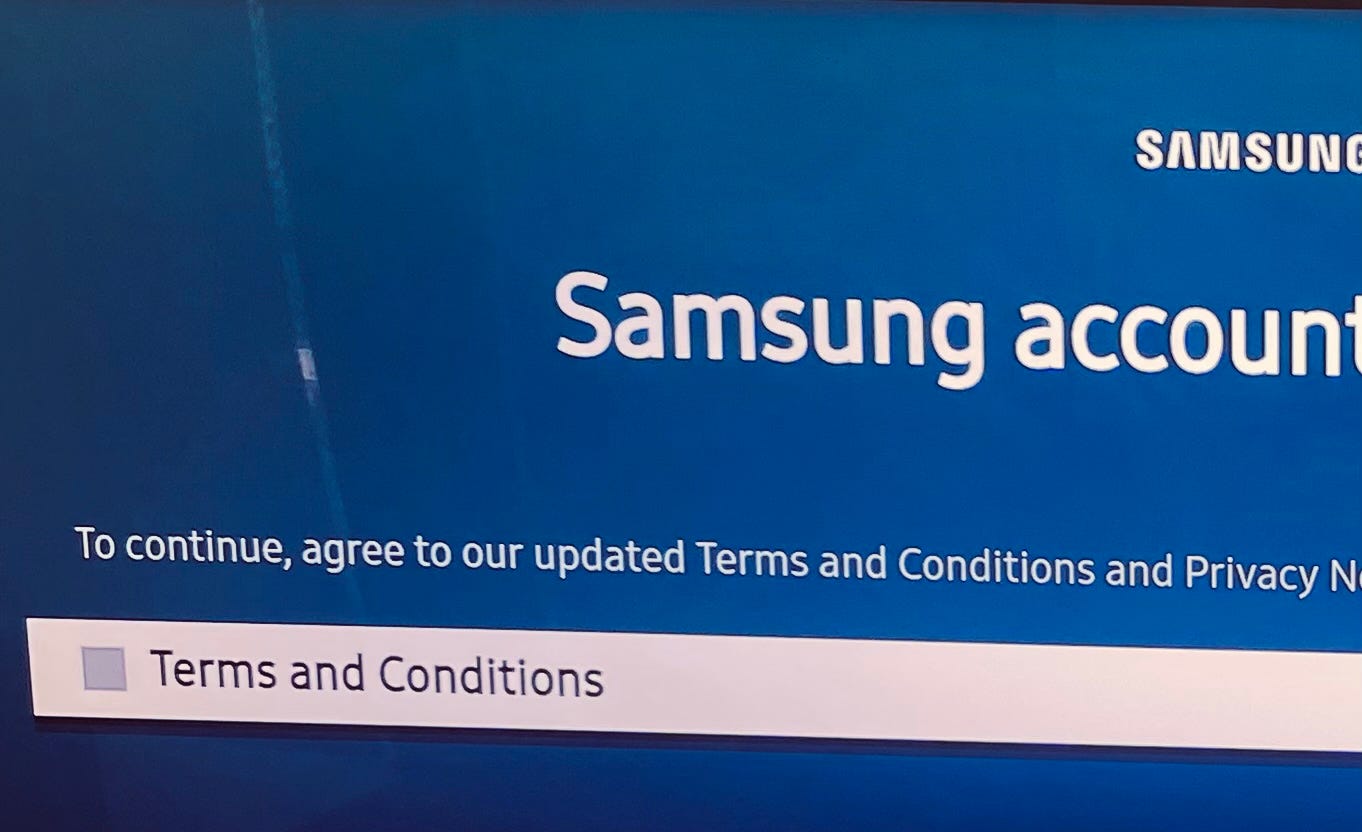
So much is wrong with signing terms and conditions like this. At the top of the list is what Samsung has in mind for children and their families.
First, the agreement requires anyone under eighteen to review the terms with a parent. Anyone under thirteen is “prohibited” from using Samsung services unless a guardian creates a Child Account. Good ideas, until you realize that virtually no one reads the document and just 1% of kids have Child Accounts.
The real reason Samsung wrote these terms comes next: A parent who lets a minor use Samsung services assumes any liability resulting from the use of those services.
Notice they say “services,” not TV or device. Because now you are agreeing to terms that apply to everything Samsung makes that connects to your kid: the Samsung account, Members, Cloud, Pass, Health, SmartThings, Bixby, Find My Mobile, Call & Text on Other Devices, Digital Key, Samsung Browser, Galaxy Store, Wallet, Rewards, Care+, PENUP, Samsung News, Gaming Hub, TV Plus.
Meanwhile, Samsung designs the data collection systems. Samsung sets the retention periods for holding your kids’ data. Samsung selects the advertising partners. And Samsung keeps shipping new AI features that use your kids to train artificial intelligence models. They are allowed to. Because you just agreed to it.
Click accept
Do you think they knew I wanted to watch the baseball game, not read their 4,600-word contract that governs my data? Do they really think kids read these documents and agree not to circumvent them, as the Samsung kids section explicitly asks of people under the age of thirteen?
Technology companies that track kids and monetize them face big legal problems, and they are scrambling to write terms and conditions that protect them from lawsuits. But it is not just liability attached to privacy invasions that scare technology companies and their lawyers.
Harming kids
In March, a New Mexico jury found that Meta knowingly harmed children’s mental health and concealed what it knew about child sexual exploitation on its platforms. After a nearly seven-week trial, jurors agreed the company made false or misleading statements and engaged in “unconscionable” trade practices that took unfair advantage of the vulnerabilities and inexperience of children. By August, a judge had ordered Meta to pay $942 million in total.
This month a federal trial opened in Oakland, where four states, California, Colorado, Kentucky and New Jersey, argue that Meta deliberately designed Facebook and Instagram to addict children and hid the harm. It is the first of the claims brought by nearly thirty states. Legal analysts estimate Meta’s exposure could reach into the hundreds of billions of dollars.
A Los Angeles jury awarded $6 million over the effects of the platforms on one young woman. TikTok, Snap and YouTube have been sued by the families of teenagers who died by suicide. In 2024, four Canadian school boards sued Meta, Snap and ByteDance for a combined $4.5 billion, claiming social media was designed for compulsive use and that the cost of the damage was transferred onto the public education system.
Teenage creators
While the platforms scramble to triage their legal problems, young people keep growing as content creators, powering the economics of Samsung, Meta, TikTok and the rest.
In the late 2000s, retouching a photograph cost $125 to $150 an hour at a commercial studio. An hour of network television cost one and a half to two million dollars to produce. Today, teenagers produce and broadcast content across the globe, all by themselves. Kane Parsons was sixteen, working in his bedroom with free software, when his Backrooms videos reached 197 million views. Charli D’Amelio started at fifteen, filming dances on her phone, and reached 100 million followers within eighteen months. Marques Brownlee was fifteen and owned no camera, so he recorded through his laptop webcam. He now has 20.9 million subscribers and 5.37 billion views.
What used to cost a studio two million dollars an hour now costs a teenager nothing.
The means of production
Kids use technology to make things that once required corporate studios and broadcast networks. Young people essentially own the means of production for content. And yet, while the platforms profit from the work of kids, the same corporations insist on writing terms that no one reads or understands.
This is short-sighted.
If a child can make the content then the same kid, and their families, can use technology to write their own legally binding terms and conditions. Hiding from the harm makes the problem worse. Passing liability to parents helps no one. Doing it with slight of hand, while I try to watch a baseball game, only shows how desperate technology companies are for a new and better way to sign contracts with children.
At Supplierism, we do not hide the fact that our “go-to-market” plan is based on families creating legally binding terms and conditions for their children. The first day that a child has access to a connected device is the day they need and deserve binding terms that protect them from surveillance and harm.