

There is almost no end to what your suppliers will do in the pursuit of your money. The spectrum includes theft, cruelty and the sabotaging of your future. It also includes penicillin, light at the flick of a switch, the refrigerator that keeps a week of food fresh, flight, and the device in your pocket that carries the accumulated knowledge of our species.
This is the first of a recurring Supplierism series that tells some of these stories, always with an eye toward harnessing the best of what our suppliers can do.
Rubber
Before 1839, rubber was a useful material with a fatal flaw: it could not survive a change in temperature. Amazonian and Mesoamerican peoples had been bouncing rubber in ball games for three thousand years. In 1770, the scientist Joseph Priestley observed that it was excellent for wiping away pencil marks, hence the English name: rubber, the thing you rub with. In 1823, Charles Macintosh sealed raincoats with it, and by the early 1830s Boston had gone briefly mad for Brazilian galoshes. Then every buyer made the same discovery in the first hot week of summer, when the coats sagged into glue and the shoes melted on the porch. By the mid-1830s, America's first rubber companies had collapsed under the stench of their own inventory.
But then, in 1839, an obsessive American inventor named Charles Goodyear discovered vulcanization, the process that stopped rubber from melting in summer and cracking in winter. It made rubber useful at last, which made it indispensable. Gaskets, hoses, belts, boots, telegraph insulation, the bicycle craze, and then finally the automobile. Goodyear patented the process in 1844 but died in debt in 1860.
The Goodyear Tire & Rubber Company was founded in Akron, Ohio in 1898, thirty-eight years after the inventor's death, by a business man named Frank Seiberling. Seiberling had no connection to the Goodyear family. The name was a tribute, chosen because it already meant rubber in the public mind. The company started with bicycle and carriage tires and horseshoe pads. But its growth was powered by the mass production of automobiles.
Rubber Trees
Rubber comes from trees that bleed latex. Only one rubber tree bleeds latex consistently good enough for tires: Hevea brasiliensis. And it grew naturally in exactly one place on earth, the Amazon basin.
Manaus sits a thousand miles up the Amazon, close to dead centre of the South American continent, surrounded in every direction by the largest rainforest on earth. In 1900 there was no road in and no road out; there still barely is. Everything arrived by water. The ships steamed in from the Atlantic for a week, deep-draft ocean liners sliding past the jungle to dock at a floating wharf, engineered to rise and fall forty feet with the river. Passengers stepped off a transatlantic vessel into equatorial heat, walked up from the water, and found electric streetlights, a tram network, and a pink-domed opera house. It is the kind of scene adventure films have been imagining ever since: the impossible European city in the jungle, the steamer arriving from another world. Manaus doesn't resemble an Indiana Jones set. Indiana Jones sets resemble Manaus.
Every pound of Amazon rubber passed through the merchants and export houses of Manaus and Belém on its way to the factories of Europe and America. The middlemen priced it like the monopoly it was. The legends of the era’s excess are famous. Rubber barons lighting cigars with banknotes, watering horses on French champagne, sending the laundry to Portugal because the Rio Negro was beneath their linen. Meanwhile, upriver, Indigenous workers were flogged, murdered and held by debt to the trading houses that supplied their tools and food at prices no season’s work could clear.
As the automobile changed the world, Manaus became one of the richest places on the planet, and every early tire on every early car began as latex from an Amazonian tree, bought at whatever price the market demanded, because there was nowhere else to shop.
The Rubber Heist
In June of 1876, a failed plantation owner named Henry Wickham walked off a chartered steamship in Liverpool carrying the future of the industrial world in his luggage. Seventy thousand rubber seeds. Three quarters of a ton of them, brought out through the customs house at Belém, Brazil as a delicate botanical collection destined for Her Majesty’s own gardens, too fragile, he implied, to survive delay. The officials waved it through.
Rubber was Brazil’s fortune, and Brazil knew it. But the monopoly was guarded by geography rather than guns. Stealing it had been tried. A British collector came home in 1873 with two thousand seeds, of which twelve germinated, but the seedlings shipped to Calcutta died. The seeds typically spoiled within days of leaving the branch, and the Amazon was a thousand miles of river from anywhere. The rubber monopoly was assumed to be theft-proof. Wickham understood precisely how precarious his plan was. He gathered his seeds near Santarém, packed them to keep them alive, chartered a ship, and sailed.
He was not acting for himself. Wickham was hired by the Royal Botanic Gardens, the botanical arm of the British Empire, with a hub in London and satellite gardens in Calcutta, Ceylon and Singapore. Wickham was paid roughly ten pounds per thousand seeds, on the instruction of Clements Markham of the India Office, who had run this type of operation once before. Twenty years earlier Markham had stolen the cinchona tree out of the Andes, the tree that makes quinine, and broken South America’s monopoly on the only drug that made malarial colonies survivable.
Most of Wickham’s stolen haul perished on the voyage. Of seventy thousand seeds, the gardeners in London coaxed roughly two thousand seedlings to life and shipped them east to Ceylon, and from there to Singapore and Malaya. And then, for twenty years, nothing happened. The trees grew. But the planters mostly ignored them, because nobody knew how to tap a rubber tree without killing it.
In the Amazon, wild rubber trees grew scattered, one tree to an acre or two. The latex tappers walked long circuits through the forest, cutting deep gouges into the trunk with an axe or a machete, sometimes ringing the tree entirely, sometimes felling it to bleed it out in a single harvest. The cuts went through the bark and into the wood, so the tree scarred, sickened, and died, never lasting more than a few seasons. When a stand of rubber trees was exhausted, the tappers pushed further upriver to virgin trees.
The new experimental plantations in Asia inverted every one of those conditions. The land was cleared, planted with rubber tree seedlings, two hundred stems to the acre; and then they waited at least seven years for the trees to mature. In the Amazon, a dead tree cost nothing. Here, every trunk had been bought and waited for, and there was no forest to move to when it died. So the new plantations had crops but no way to harvest the latex.
The man who solved the problem was Henry Ridley, director of the Singapore Botanic Gardens, who worked out a shallow herringbone cut that opened the latex vessels without wounding the tree, so the same trunk could be bled every other day for thirty years. It is still how it is done.
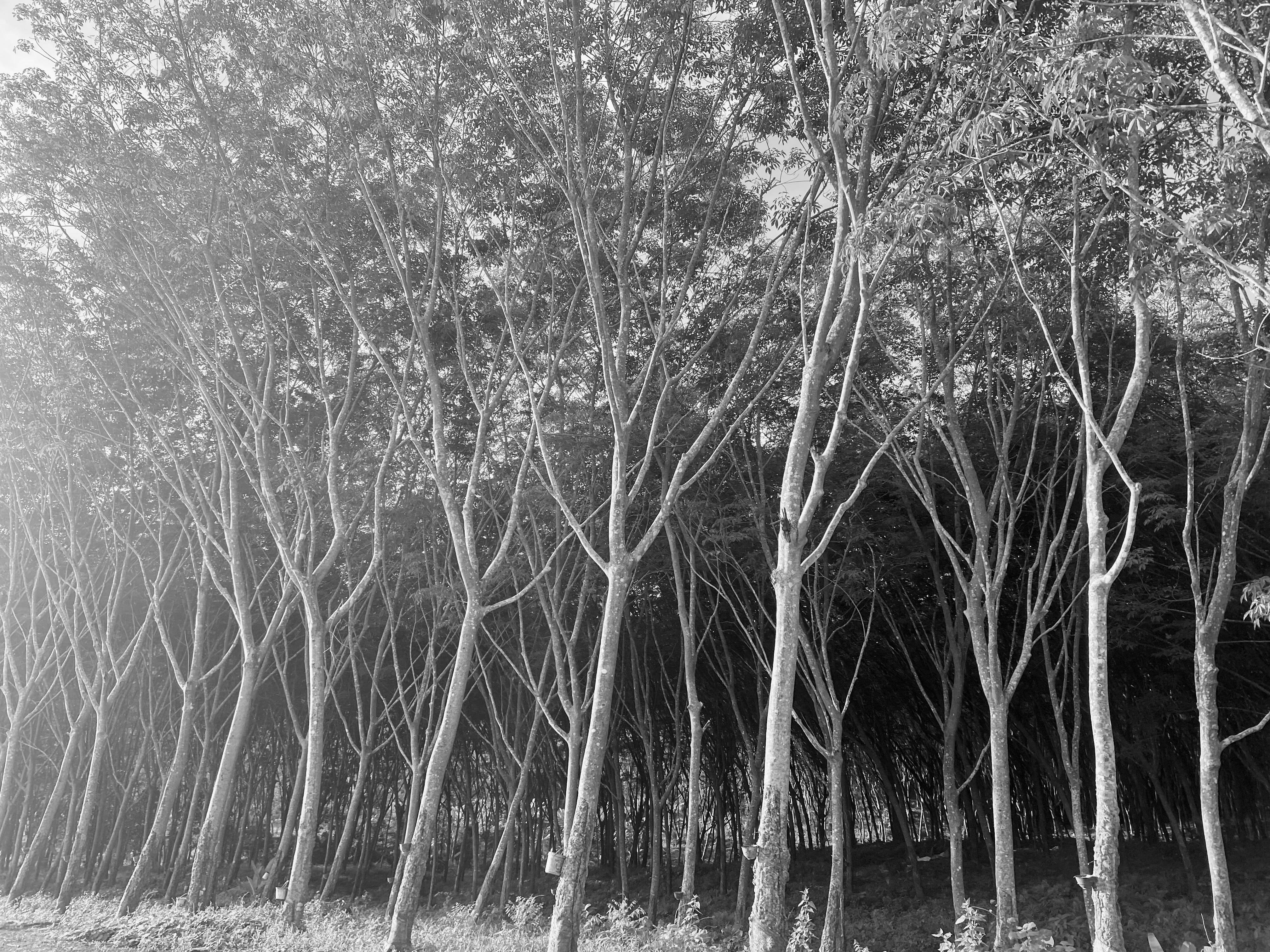
A rubber tree plantation on the island of Koh Lanta, Thailand, 2020. Each tree is a descendant of the Brazilian Rubber Tree Heist of 1876 .
Then the timing turned. Coffee rust had just destroyed Ceylon’s coffee crop and left its planters ruined and desperate. The bicycle craze arrived, and behind it the automobile, and the price of rubber went vertical. So the broken coffee men planted Wickham’s trees with Ridley’s cut, and from 1897 the plantations spread across Ceylon and Malaya.
It took thirty-seven years for that crate of rubber seeds in Liverpool to bankrupt Manaus. The collapse was total. In 1900 the Amazon produced ninety-five percent of the world’s rubber. By 1913 the Asian plantations, every tree of them descended from Wickham’s crates, out-produced the Amazon. By 1916 Goodyear owned twenty thousand acres of rubber trees in Sumatra. The buyer that once paid a monopoly’s price now grew its own supply on the fruit of the theft that ended the monopoly. By 1928 Brazil's global share of the rubber industry was two percent. The price broke. The barons left. The trams stopped. The opera house sat empty as the jungle grew back around it.
Fordlandia
By the 1920s the tables had turned completely. Now Britain held the supply of rubber. When London moved to restrict rubber exports and lift prices, the world’s largest rubber buyer decided to fight back. Henry Ford’s cars rolled on rubber, and America was consuming three quarters of the world’s output. Tired of paying a foreign cartel, Ford bought 2.5 million acres of Amazon rainforest, a parcel roughly the size of Connecticut, and set out to grow his own.
What he built was Fordlandia: an American town in the jungle, with Michigan-style bungalows, fire hydrants, a golf course, a modern hospital, electric light, running water, and mandatory square dancing, which Ford considered morally improving. It was foolhardy and arrogant: Ford hired no botanists and no tropical agronomists, staffing the plantation with Michigan managers who had never grown rubber. The land itself had been chosen badly, hilly and sandy, sold to him through intermediaries who took their cut. Workers were paid double the local wage and in exchange were expected to live as Michiganders: punch clocks in the rainforest, ID badges, whistle shifts alien to locals who had always tapped trees in the cool of dawn, alcohol banned outright, and American food in the cafeteria.
In December 1930, a menu of oatmeal and canned peaches set off a riot; workers smashed the time clocks, wrecked the mess hall, and pushed trucks into the river while the managers fled to boats offshore. The Brazilian army was called in to restore order. Upstream, beyond Ford’s writ, an island of bars and brothels flourished.
But what actually defeated Ford was a tree fungus. South American leaf blight lives in the Amazon. Rubber trees survive it by growing far apart. Ford’s engineers planted trees in tight, efficient rows, and when the young canopies finally touched, the blight moved through the plantation like fire through a woodpile.
Meanwhile, the trees stolen from Brazil and farmed in Asia were now safe from the Amazonian fungus.
Ford closed the Brazil operations. He had spent about $20 million, over $200 million in today’s money, without ever visiting the place, and never put a Fordlandia tire on a production car. In 1945, his grandson sold everything back to Brazil for $244,200, about a penny on the dollar.
Rubber and War
In 1942, Japan seized Malaya, Singapore, and the Dutch East Indies, and with them some nine tenths of the world’s natural rubber, the same plantations Wickham’s seeds had built.
The war consumed massive quantities of rubber. About half a ton in a tank, twenty tons in a battleship, and tires under every truck, jeep, and bomber. America had less than a year’s stockpile. A presidential survey committee led by Bernard Baruch concluded that of all scarce war materials, rubber was “the greatest threat to the safety of our nation.”
Most people have forgotten what came next, or simply get it wrong. Gasoline rationing during World War II, the great shared sacrifice of the home front, was imposed in large part not to save gasoline. It was imposed to save tires. The national Victory Speed limit of 35 miles an hour existed because tread wears faster at speed, and the American government had done the arithmetic on every tire in the country.
Motivated by an existential crisis, the government mobilized to find a solution to the rubber shortage.
The recipe for synthetic rubber, called Buna-S, actually came from the Germans. Buna-S is butadiene and styrene, polymerized — a rubber made from petroleum and coal chemistry instead of tree sap. Standard Oil owned the American patent rights for Buna-S through a prewar agreement with the German chemical cartel IG Farben. Barely three months after Pearl Harbor, Standard Oil was hauled before Harry Truman's Senate committee. Under that pressure, and a simultaneous antitrust case, Standard Oil was forced to release the patents for the war effort.
The government then ordered the rubber rivals, Goodyear, Firestone, Goodrich, US Rubber, to pool their resources inside dozens of government-built plants. The cost of the synthetic rubber project was roughly $700 million, billions in today’s money.
In 1941, the United States was facing a rubber shortage that could have cost the Allies the war. By 1944 it produced nearly 800,000 tons of synthetic rubber and by the war’s end almost nine of every ten pounds of rubber in American use were synthetic. A synthetic rubber industry that had not existed when Japan bombed Pearl Harbor, rolled the Allied armies into Berlin in 1945.
It was one of the great procurement feats in history.
A government sponsored botanical espionage and waited decades for seedlings to grow into leverage. An automaker bought a Connecticut-sized piece of a foreign country and built a town with a golf course in it. A wartime nation on the brink invented a substitute industry from scratch in three years.
And we can’t stop forest fires? Can't stop the ocean from filling with plastic? Can't build a house a working family can afford? Can't keep a supply chain free of forced labour?
History tells a different story. If your supplier is sufficiently motivated, there is almost nothing it cannot — or will not — do.
Note: this post is a bit longer than most. Next week’s will be shorter.