

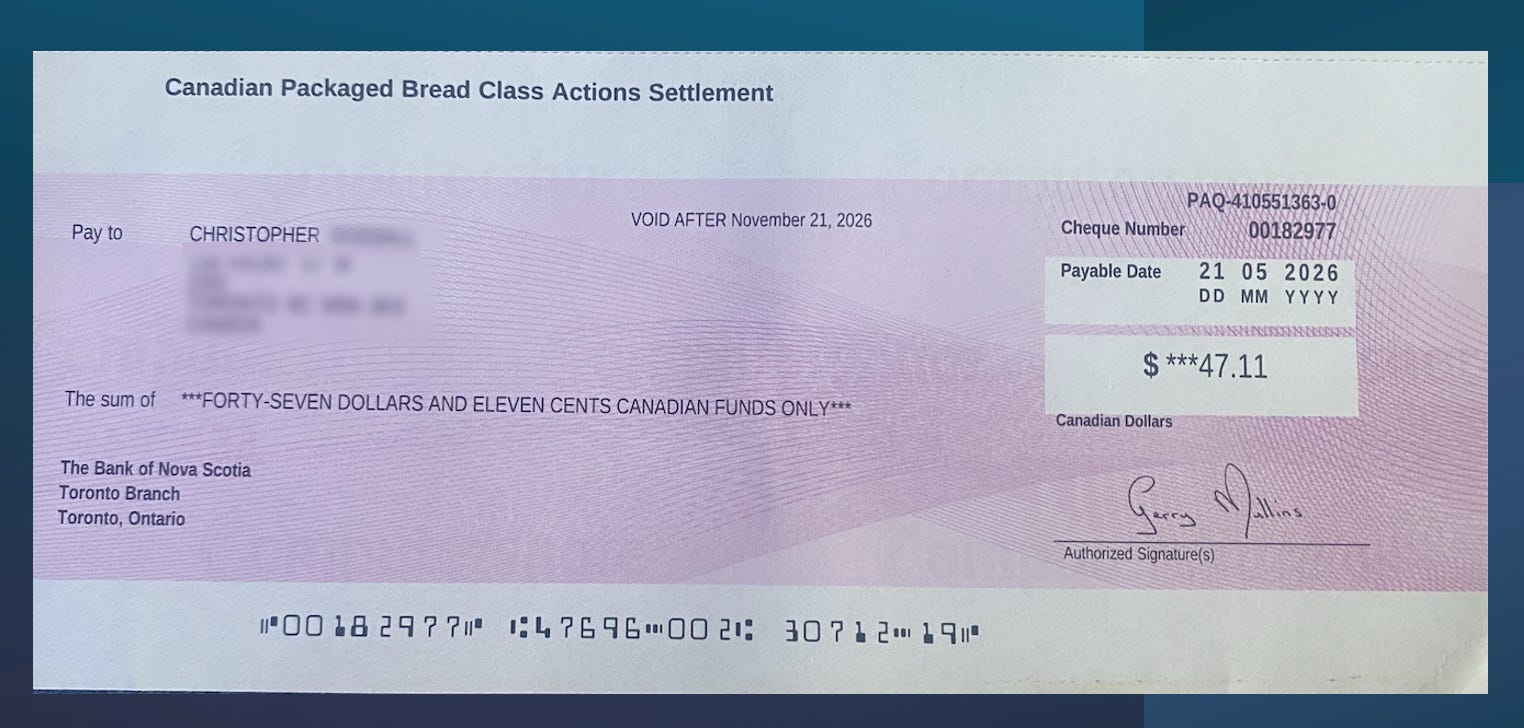
What can George Weston and my old dog Smoke teach us about multi-billion-dollar corporations? The answer runs through a price-fixing scheme that inflated the cost of bread in Canada for fourteen years. It ends with a $47.11 cheque that landed in my mailbox this month. My share of the $500 million settlement paid out by George Weston Limited, the owner of Loblaw, Canada's largest grocer.
But the story doesn’t begin with corporate scandal. It started over a hundred and fifty years ago, with a kid, a wagon, and something to sell.
The Baker
Around 1868, George Weston's family moved from Oswego, New York to Toronto. George was four at the time, the youngest of seven children. He got a thin education, and at twelve went to work in a bakery for a dollar seventy-five a week. He learned the trade with his hands. By seventeen he had saved enough to buy two bread routes from his boss for roughly two hundred dollars. For a labourer's son that was not pocket change.
In 1884 he bought the bakery itself. He liked to tell the story of the first day. Two hundred and fifty loaves, baked by him, loaded onto his own wagon, delivered to every customer by his own hand. George met his wife, Emma Maud, on one of those routes. He called his product Real Home-Made Bread, and within a generation he was the largest baker in the country.
In the 1890s the bakers of Toronto had come up with a scheme. Their association agreed to hold the price of a loaf of bread at twelve cents, so that nobody undercut anybody else. A price-fixing pact. Canada had already passed the world’s first antitrust law in 1889. But it was a near-dead letter with a single failed prosecution in its first decade. Price-fixing was technically a crime but effectively unpoliced.
George Weston broke the pact. He walked out of the association and cut his prices below the agreed number. Prices across the city fell, which mattered most to working families for whom bread was a staple. A couple of pennies off a twelve-cent loaf was real money saved every single day.
George Weston was a hard-driving entrepreneur. He cut prices to win, paid his workers poorly, and had a fine sense of exactly what a customer would tolerate. And yet there was decency in what he made. He baked a loaf cheap enough for families who could not afford to bake their own, in a bakery clean enough that the newspapers praised it at a time when most food was made in filth. Cheaper, safer bread for people who counted every penny. That is not nothing.
The Dog
Smoke, the dog, came into my life in 1980, when I was eleven. I think my father recruited him to explain the hard parts of divorce to me and my brothers, the parts he couldn't manage to explain himself. Smoke became the emissary into a new life. Not with words, of course, but in the way only a dog can turn a summer day that could have been lonely and grim into something sunny and fun. He was a master at exactly that. Warm and elegant, loyal and stately, he ushered me through that change and smoothed over rough patches that are barely memories now, thanks in part to him.
But he was also just a dog. He drank out of the toilet bowl. He chewed my socks into wet ribbons. He soiled the carpet when it suited him, and he stole my dinner whenever I left it within reach. I didn’t take any of it personally. I never once asked him to be polite or ethical. I tried to train him to be good. In the end, he was half-trained and beloved. A thief? Yes. That was his nature.
There is an old saying that there are no bad dogs. Just bad owners. How comfortable are you with the following variation?
There are no bad corporations. Just bad buyers.
The Corporation and the Cheque for $47.11
George Weston died in 1924. In 1928 his son Garfield took the bakery George had built, incorporated it as George Weston Limited, and listed it on the Toronto Stock Exchange.
Not a baker anymore. A security. A thing you could own a piece of without ever tasting the bread. From then on the company answered to different stakeholders. Not just regular people at the door, but shareholders on the exchange, who wanted growth and cared less about how the loaf tasted, so long as it made money.
And grow it did. Garfield was a brilliant, restless acquirer. Across the thirties, forties and fifties he bought biscuit makers, paper mills and fish canneries, anything that turned a margin. In 1953 he took control of Loblaw, and the bakery that once delivered bread now owned the shelves it was sold on.
Garfield’s son Galen Weston Sr. took over in the 1970s. By the end of the decade, George Weston Limited was a multi-billion-dollar holding company. The wagon was a logo. The baker was a portrait on a wall.
Somewhere around 2001, George Weston Limited and Loblaw began coordinating the price of bread, nudging it upward in lockstep with competitors. It was almost precisely the pact the original George Weston had rejected in the 1890s. The man broke a price-fixing cartel. The corporation bearing his name perfected one.
How did this come to be, under the watchful eye of leadership that can fairly be called sensible and conservative?
According to the company, it discovered its own price-fixing in March 2015, immediately reported it to the Competition Bureau, and cooperated in exchange for immunity from prosecution. By 2017 Galen Weston Sr. had retired and handed the parent company to his son. When the media broke the story that December, Galen Jr. answered for the company. He called the scheme "a difficult matter" and "clearly something that never should have happened."
Seven years later, when the $500 million settlement landed, he said it again: “This behaviour should never have happened.”
Last month, my settlement cheque arrived.
With three kids at home, I figure I bought over five hundred loaves of bread between 2006 and 2015, overcharged by at least $350. Add a modest interest charge and they owe me about $700. Charge the company the rate it puts on its own credit card, around 19%, and George Weston Limited should pay me closer to $4,000.
The cheque was for $47.11.
For nearly a decade and a half, George Weston Ltd and Loblaw helped overcharge customers an estimated $5 billion for bread. They held the money for years, handed back about a tenth of it, and paid no criminal penalty. That isn't a deterrent. It's a cheap loan, taken without asking, repaid late and in part. Meanwhile, throughout those years, the executives running the company drew their salaries and bonuses, like any other profitable year.
Does your dog bite?
“This behaviour should never have happened,” said Galen Weston Jr.
Only half-trained, George Weston Ltd was like a dog that can't be left alone with your dinner. It never stopped sniffing around for easy profit. Galen Jr.'s words frame price-fixing as a stray impulse, something to report and apologize for, the way you might if your dog slipped its leash.
I think there's a lot to learn from this: corporations can't be trusted to make ethical decisions any more than Smoke could be trusted with my pizza. They need training.
In capitalism, our corporate suppliers are constantly seeking profit. It's their nature. When we train them to be good, they learn that harm is a cost they can't pass on to us. When we don't, they will overcharge us for bread the moment they think they can get away with it.
A few years after Smoke died, I was jogging in a secluded ravine, aged nineteen. A hundred-pound Bouvier attacked me and sent me to the hospital covered in blood from head to toe. I still have the scars. Bad owner? For sure. But I can honestly say it was a pretty dangerous dog too. Not evil, just a dog that nobody had trained, doing what an untrained dog can do.
Some of your suppliers are surely helping to make your life more meaningful, interesting, even beautiful. Some are likely smoothing over the rough patches, the way Smoke did. And some remind me of that Bouvier, attacking our way of life and our safety.
The main point is this: make sure your money trains the ones you like to be good, and disqualifies the ones that behave badly. Price-fixing, carbon emissions, corruption, exploited labour, poor safety, jobs automated away by AI. These are all things we can fix when suppliers are forced to own the costs they create.
How?
Imagine if every one of my bread purchases came with a contract that said:
Price-Fixing. The Supplier warrants that this price was set competitively and not fixed or coordinated with competitors. If it was, the Supplier shall refund every overcharge in full, automatically and without any claim, plus 19% annual interest from the date of purchase, the same rate it charges on its own credit card.
Instead they paid me $47.11, over ten years after the crime was committed.
Setting your terms now, before you buy products and services, changes the game. We're building a free app to do exactly that.
What kind of buyer are you? Nine questions, about two minutes, and your terms follow.