Supplierism argues two basic things.
First, our lives are shaped by our suppliers. Food, clothes, music and media, travel, the smartphone in your hand or the computer in front of you. It is impossible to imagine life without the things made by our suppliers. At the same time, nearly every large-scale problem in the world, from political corruption to climate change to AI undermining humanity, runs through the choices our suppliers make with our money.
Second, to secure a safe and prosperous future, people must influence the behaviour of their suppliers through contracts that reward good performance and punish bad results.
Supplierism is not a new system of government, not a new economic theory, not a philosophy of life. It invents nothing. Every mechanism it relies on already exists, is already legal, and already works. Supplierism is a new word for something very old.
So, let’s start at the beginning.
Writing was not invented for poetry or prayer. It was invented for keeping track of goods. The oldest documents humanity produced are procurement records pressed into Mesopotamian clay. The earliest name we can still read does not belong to a king or a prophet but, most scholars think, to Kushim, a procurement administrator in the city of Uruk around 3100 BC. His name survives because it appears on a receipt for barley: 29,086 measures, received over 37 months. The first thing civilization chose to record was the delivery of products from a supplier to a buyer.
By 2600 BC the sales contract had arrived. A tablet from the city of Shuruppak, now in the Louvre, records the sale of property, with witnesses named at the bottom to vouch that the deal was honest. Terms, parties, witnesses. The form was set before the pyramids were finished.
Around 1750 BC, we get the first record of a buyer asserting their rights against a supplier. In the Mesopotamian city of Ur, a man named Nanni paid a copper merchant in advance. By Nanni's account, the merchant explicitly promised good quality copper ingots. Nanni’s messenger crossed hostile territory to collect the copper. What he got instead was inferior product and a shrug.
“If you want to take them, take them,” said the copper merchant. “If you do not want to take them, go away!”
So Nanni pressed his fury into a clay tablet. It is the oldest written customer complaint on record, and today sits in the British Museum. It reads with the same frustration you and I have likely felt recently, buying something defective:
“What do you take me for, that you treat somebody like me with such contempt?”
Having vented, Nanni’s tablet then dictates his terms and conditions.
“I will not accept here any copper from you that is not fine quality. I shall select and take the ingots individually in my own yard. And I shall exercise against you my right of rejection because you have treated me with contempt.”
A remedy, a quality clause, an inspection clause, a consequence. Alone, with no state behind him and no leverage but his own money, Nanni wrote a procurement contract in the form of a complaint.
Everything since has been layers on that foundation.
Rome added the competitive tender and the performance bond: contracts auctioned by the censors, five-year terms, guarantees posted by the winner. The Royal Navy added the inspector, appointing surveyors in the 1660s to check what its contractors delivered, and splitting supply among rival firms so no one held a monopoly. Lincoln added the fraud penalty. After contractors sold the Union Army diseased horses, faulty rifles, and gunpowder cut with sawdust, he signed the False Claims Act in 1863, which let ordinary citizens sue cheating suppliers and keep a share of the recovery.
In 1887 the first book on the procurement discipline appeared. By 1915 the purchasing agents of America had a national association, and soon a profession: credentials, journals, conferences, careers. In 1952, the Uniform Commercial Code gathered the rules of buying and selling into a single rulebook. In the 1980s, Toyota taught the world to develop suppliers rather than merely squeeze them. Later in the century, large buyers added the first ethics clauses with terms about the seller’s social, environmental and governance conduct, enforced by audit and cascaded down the supply chain. By the end of the 20th century, the procurement department of a large corporation was the most sophisticated buyer the world had ever produced.
Next, the corporation did something that changed the world again.
It took its mastery of procurement contracts and aimed it at its own customers. It printed its own terms on the back of the ticket, inside the policy, in the fine print. Liabilities were limited, then quietly passed on to the buyer (you and me).
By 2000, the computer click had replaced the signature. The corporation simply used its size and its head start in technology to create advantages at the moment of sale. None of its techniques were new. It’s just buyers, sellers, and contracts — as old as haggling for copper ingots in Mesopotamia.
But this life-shaping relationship is a pendulum, and the gravity that moves it is the buyer's money. That is the natural order of economic life. The buyer holds the greater force. In the 21st century, corporations used technology, tricks, and lobbying to pin the pendulum on their side, making the buyer's agreement to the seller's terms feel like the only option. That is now changing, because the same technology that pinned the pendulum can level it. Buyers in a global economy can finally write terms of their own, at the same scale as the corporations they face in everyday purchasing.
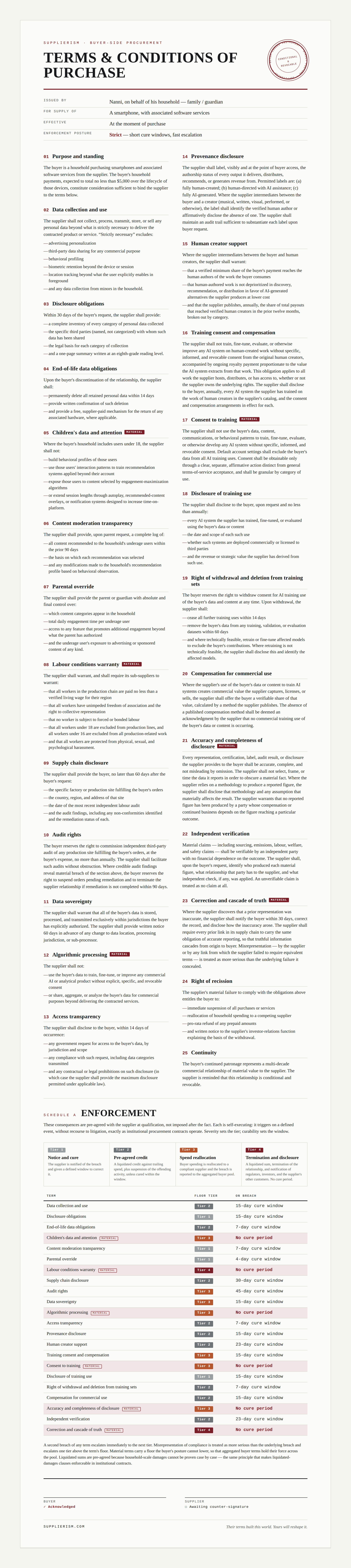
Which makes me think: if Nanni lived in 2026 and was buying his daughter a smartphone or a tablet, he would reach for Supplierism's free tools to write the purchasing contract pasted below. Soon, terms like his will be created and executed with the supplier instantly, through the buyer's own purchasing app. His original document took a scribe, a stylus, and wet clay.
If you don’t want to read Nanni’s entire supplier contract, here is the summary of his terms, in Nanni’s own register:
Supplier — take only what you need. Leave my child be. Do not feed my words to your machine. Tell me the whole truth or none. Break faith and my silver is gone, and a thousand households hold the same tablet. You need my silver more than I need your wares.
— Nanni