

What is Supplierism?
Here is how Google defines it:
Supplierism is an emerging economic framework and consumer advocacy movement focused on giving ordinary buyers the same procurement-grade negotiating power that large corporations and institutions use.
The concept addresses the idea that major corporations quietly shift hidden societal and environmental costs—such as climate liabilities, data breaches, and pay inequities—onto consumer balance sheets. Instead of traditional regulation or passive consumer boycotts, supplierism provides tools for everyday buyers to write, dictate, and collectively enforce their own transactional terms on major companies.
What are we building?
We are building a free app that turns your interests and concerns into terms and conditions that your suppliers can agree to.
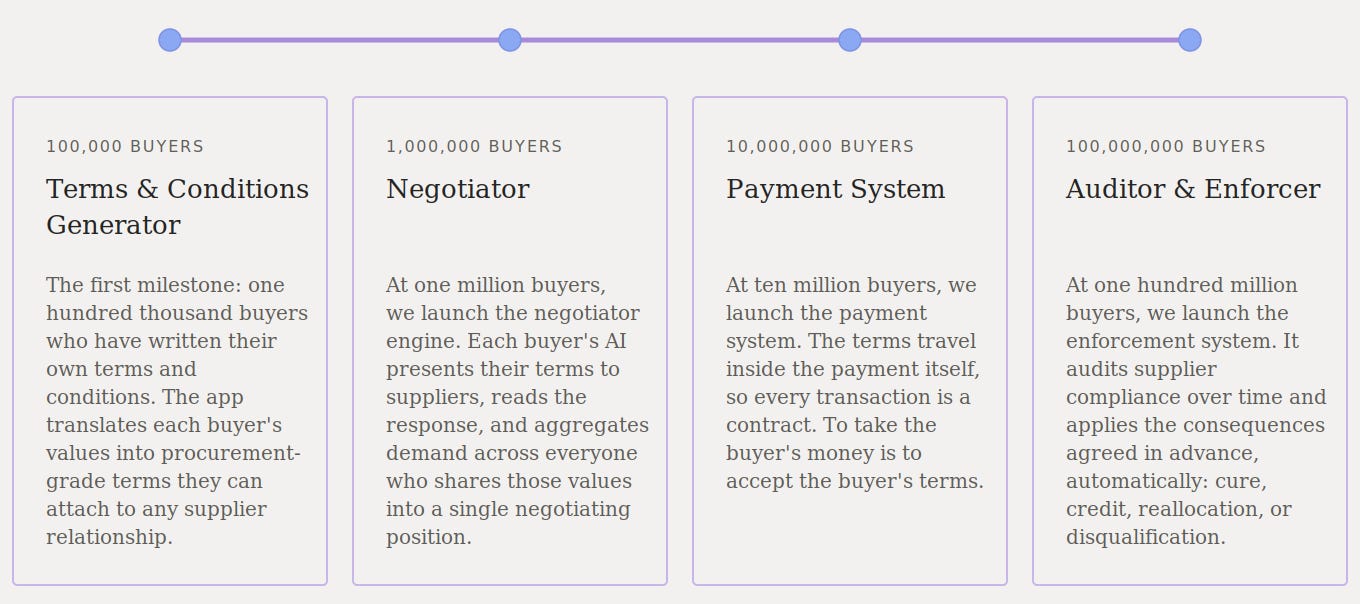
The goals are:
Get 100,000 people to create their own terms and conditions using the free terms generator.
Launch the negotiator feature with one million users.
Build the payment system that works like Apple Pay, but includes your legal terms & conditions with every purchase.
And finally, create the auditor and enforcement system so that your suppliers do what they agreed to do.
Big steps forward
At Supplierism.com, you can already create your own terms and conditions for free. That part is done. Will it get better? Much. But the tool works and anyone can use it.
We also started an education campaign. Discussion guides, activities, case studies, and assignment templates are available for elementary, high school, and post-secondary classrooms.
We are now conducting research to support how the app will read your suppliers’ disclosures. This is how the app decides whether a supplier meets your terms or doesn’t. We have built a program to test whether companies can easily publish machine-readable data for consumer accountability. The findings are very promising.
Using AI to solve human problems
My friend Keith likes to joke that I am a scientist because, technically speaking, I earned a graduate degree in science at the University of Bath, where I studied the relationship between Responsibility and Business Practice. Keith and I also ran a nonprofit together in Montreal.
We both know that I am no scientist, hence his joke. And I am certainly not a computer programmer.
Despite this, AI makes it possible for me to write real, working software that targets big problems. All of my coding is AI-generated. And everything built so far at Supplierism has cost zero dollars to make.
Supplierism and AI
There is a second reason AI matters here, and it has nothing to do with how the software gets written.
It’s about our relationship with AI. The vast majority of people distrust it. In poll after poll, people believe AI will do more harm to humanity than good. That fear is real, and so are the risks.
We believe that legally enforceable terms and conditions change your relationship with AI. They are a set of text instructions to be followed. Give an AI model or agent those instructions and the questions it can ask change completely.
Is this human-made or AI-made?
Is this truthful or not?
Fair or unfair?
Safe or unsafe?
Just or unjust?
Your terms spell out what those words mean in the place they actually matter: where your money changes hands with your suppliers.
Meanwhile, AI has started to do transactions. It books flight, fills the cart, renews subscriptions, compares quotes. Every one of those actions is a purchase decision made on your behalf, by something that has no idea what you care about.
Without knowing your terms and conditions, AI optimizes for the only things it can see, like price, speed, availability. Once it reads your terms and conditions, and knows the type of future you want, then it can optimize for your human interests in addition to price, speed, and availability.
Progress
With the above in mind, I recently wrote a computer program that visits corporate websites and looks for specific files. It’s the same thing your browser does when you visit a webpage. It asks a server for an address and gets an answer back. Except my computer program does it for a list of companies and records what came back.
The program keeps everything. Every page it fetches is saved, with a fingerprint that proves it hasn’t been altered since. So when a company disputes a result, the answer isn’t an argument. It’s the actual bytes their server sent, on that date.
It’s allowed to say “I don’t know.” Every check comes back as yes, no, or couldn’t tell. If a server is down, or refuses the request, or answers in a way that can’t be interpreted, that is recorded as an unknown rather than counted as a failure. Percentages are calculated only over the checks that produced a real answer, and the unknowns are reported alongside.
What we found
The program was pointed at the websites of 146 regulated financial service companies.
Of the 146, 126 could be assessed using my Supplierism crawler. Of those 126:
– 98.2% have a privacy policy findable in one click.
– Zero publish a machine-readable disclosure endpoint.
The second bullet is important. These companies publish disclosures for people to read, because the law requires it. But their data is not yet published as machine-readable.
So, can corporations produce disclosures to match your terms and conditions for the things you care about? Yes, most already do. It’s just written for a human to read, not computer software.
Could a simple program read corporate disclosures, if they were published in a readable format?
YES
That’s what we proved this week.
The gap isn’t technical. It is actually very simple to implement a system that allows an app to read the disclosures of your suppliers. This is big deal for Supplierism. The files in question are a few lines of plain text. Any corporation or institution with a website can post machine readable data about their disclosures in minutes and at no cost to them.
What’s missing is a reason to. No regulator has asked for it and no competitor is doing it.
And, until now, nobody was poking around to see if your terms and conditions could be connected to your suppliers disclosures. And guess what? They can.
Next week, we return to a more regular post.