

If you’re like me, and an estimated one billion other people, you genuinely love watching the World Cup. Another two to three billion watch casually, dipping in for the spectacle. How many of us are tired of juggling the fact that FIFA does not deserve our business?
What is FIFA?
FIFA, the Fédération Internationale de Football Association, is the Zurich-based global governing body of football, founded in 1904, that organizes the men’s and women’s World Cups and collects the broadcasting and sponsorship revenue they generate.
The 2023-2026 World Cup cycle is now projected to generate $13 billion for FIFA, up roughly 72 percent on the previous cycle that ended with Qatar 2022. FIFA keeps the broadcasting, sponsorship, and ticket revenue, while the host cities and governments largely absorb the costs of security, transport, and stadiums. In Canada that means about C$1.066 billion in public support, roughly C$82 million for each of the thirteen matches the country is staging.
About $3.2 billion is paid to FIFA directly through ticket sales. The other $9.8 billion reaches FIFA indirectly through broadcasters and through sponsors like Adidas, Coca-Cola, Hyundai-Kia, Visa, Aramco, Lenovo, and Qatar Airways, who front the money and then recoup it from you in the price of a Coke, a Visa swipe, a car, a streaming subscription.
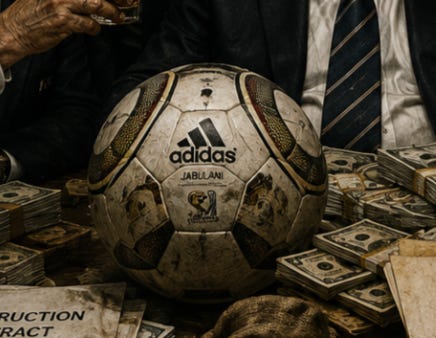
Breaking laws and funding Putin’s war
FIFA has become a byword for institutional corruption, built like a global syndicate: six confederations, a 37-member Council as the commission, and a president who keeps power by controlling the money that flows down to the 211 federations and the loyalty that flows back up as votes. It answers inward, to the federations it bankrolls, and never to the fans and host cities whose money funds the whole operation. When U.S. prosecutors charged FIFA officials in 2015 they used laws written for the mafia. That RICO case described more than $150 million in bribes and kickbacks, charged as racketeering, wire fraud, and money laundering.
The conclusion was that the body entrusted with the world’s most beloved game is run, in significant part, as a racket. Most of the money comes from you and me, vacuumed up, washed clean, and then repurposed for whatever scheme FIFA’s partners choose.
Russia is the most disturbing. The 2018 World Cup was a soft-power triumph for Putin, who had already annexed Crimea in 2014 and used the prestige and revenue of FIFA’s World Cup to entrench his regime, before launching the largest land war in Europe since 1945.
Western sponsors, and the brands you and I buy, effectively bankrolled the war in Ukraine. The money trail runs disturbingly straight. You can read more about that here: How your money funded Putin.
The dilemma has a name
There’s a name for loving a product and distrusting it at the same time. Wharton School researchers (Bhattacharjee, Berman, and Reed) call it moral decoupling. Separating judgment of the product’s performance from judgment of its morality allows buyers to admire one while condemning the other, without pretending the bad thing was fine. It’s different from making excuses, and it’s easier to live with, precisely because you never have to lie to yourself about the wrongdoing.
That’s how many of us experience FIFA. The game is great. Its managers are overpaid, prone to corruption, with a habit of consuming public resources that could otherwise be used for education, health care, or lower taxes. So we hold our noses.
FIFA is a glaring example of moral decoupling. Regular people all around the world finance terrible results as buyers of everyday products. These results betray not just our values, but our economic interests too.
Lately, I have been experimenting with various AI platforms to see what they have to say about humans spending their hard-earned money to fund poor results from their suppliers. One basic conclusion stands out.
Money is power. Giving yours away to your suppliers without also asking for guarantees undermines your future interests.
Moral decoupling is a consumer survival tactic that is understandable and regrettable at the same time. It lets us enjoy the product with our eyes open about rotten owners and managers, like FIFA. But it also delays what AI is predicting: that citizens will soon realize moral decoupling betrays not just our values, but our economic interests too.
Supplierism is designed to make sure we don't surrender our money to suppliers before they have agreed to reasonable terms and conditions. People drawn to the idea of Supplierism are sometimes skeptical of how it can be executed at scale. There is a sense that regular people are limited in what they can do. But for ChatGPT, Claude, and Gemini, creating and enforcing legal contracts with our suppliers is not complicated at all. Standard terms can be drafted once and offered to millions, agreement can be tracked automatically, and buyers can be aggregated into a bloc no single supplier can ignore. The idea of requiring our suppliers to sign contracts is so simple that moral decoupling starts to look like what it always was, a workaround for people who thought they had no other choice. I picture the AI scratching its digital head: Giving money away without first agreeing how it can be used? Financing the outcomes you spend your life trying to avoid? The math doesn't work.
Supplierism is a plan to end moral decoupling for good, so you can love the game and trust the people who run it.