

Words are sometimes little fossils. Making sense of them can be hard.
Take the word movies. There are no moving pictures anymore, no strip of celluloid clattering through a projector. Yet we still film things that touch no film, measure them in footage that is no longer feet of anything. We hang up phones that have no hook to hang on. We roll down windows by pressing a button, dial numbers that have no dial, and cc colleagues referring to carbon paper that no one has touched in forty years.
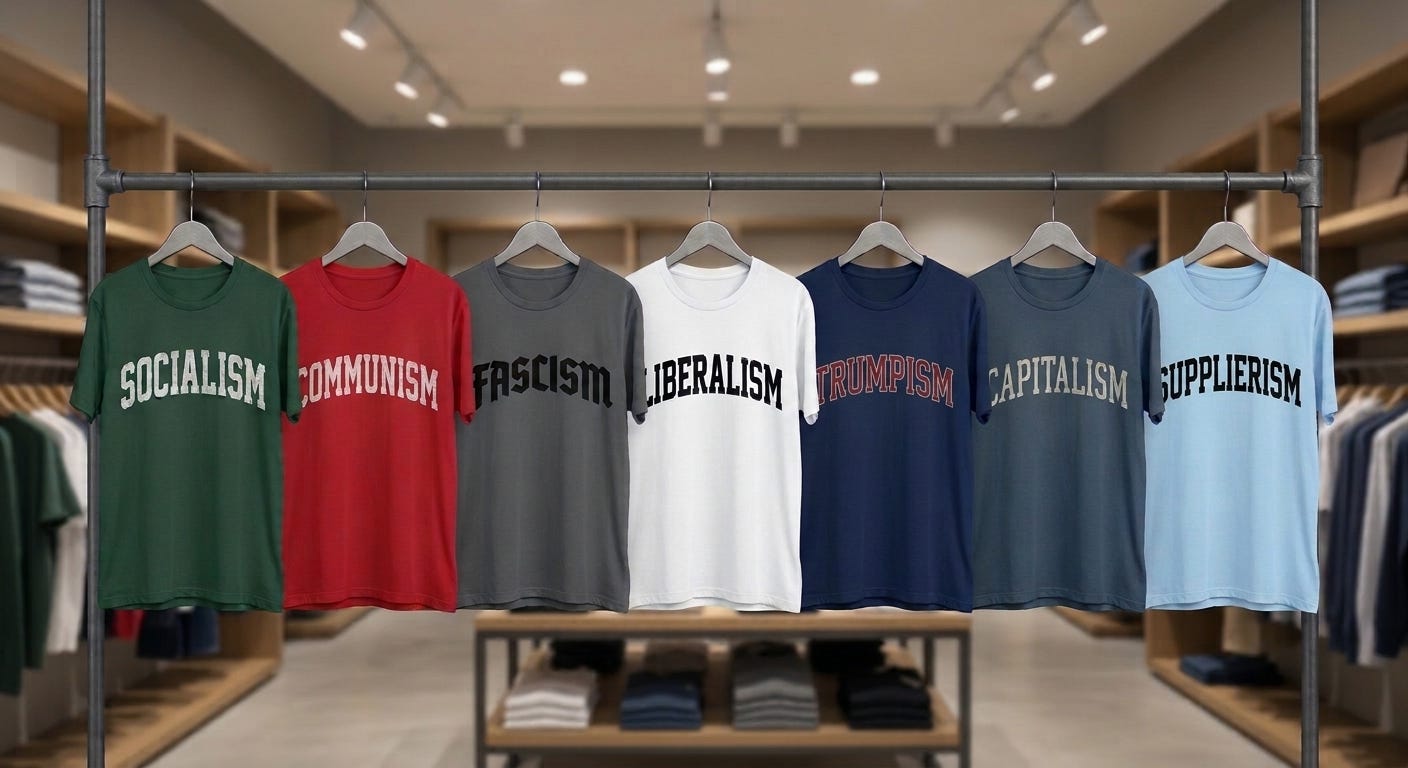
Some word families are more fossilized than others, yet they resonate the loudest, even as we fail to hear them for what they are, or where they came from. No family of words embodies this more than the ones built on the suffix: -ism. Capitalism, socialism, liberalism, Marxism, Trumpism, to name a few. Three letters that turn a noun into a worldview. But the longer you look at them, the less sense these competing isms make of the world we actually live in.
Which brings me to the word Supplierism, and the reason it was coined.
-Ism comes from the Greek -ismos. It took a verb meaning “to do something” and made a noun meaning “the doing of that thing.”
Baptism is an archetype for -ism. It begins as the action of dipping a person in water. But baptism is never just the moment it occurs. It reaches out to cover the rite, the vows, and the doctrine of what the water is supposed to do to a soul. One word holds both the act and the entire system around it.
Papism, atheism, and paganism all follow the same dual structure, but these Reformation-era uses remind us that an ism often starts as a label pinned on a group of people, usually in contempt. Papism was never what Catholics called themselves. Atheism defines people by what they are accused of lacking. Paganism and heathenism were really just insults for people living at the outer edges of society. Pagan comes from the Latin for a country-dweller. A heathen was someone who lived on the heath, the scrubland past the last house in town.
As always, English meanders away from reliable rules. Sophism, syllogism, and barbarism are obviously not worldviews. In fact, they reveal the second life isms lead, one that has nothing to do with creeds. At their humblest, isms shrink into utterances. A witticism is a witty remark. A malapropism is a word comically misused. A colloquialism is a casual turn of phrase. And a euphemism is a hard truth softened into something easier to say.
At the other end of the spectrum, great creeds defined by their ism are singular and vast. There is only one Buddhism, for example. Versions and derivatives, yes, but all pointing at a single worldview.
The founder-isms stand out: Calvinism, Lutheranism, and Trumpism are not acts or ideas. They are doctrines defined by whatever Calvin, Luther, and Trump happened to teach.
More often than not, to name something an ism is to define it from the outside by standing back far enough to see the whole system. A striking number of isms were coined by observers, or opponents, before the people inside them ever adopted the name. Marxism is the most famous founder-ism, imposed from the outside on the very person who rejected it, since Marx himself reportedly said “I am not a Marxist.”
Somewhere in the eighteenth and nineteenth centuries, the bolting of -ism onto big ideas took off. Think of liberalism, nationalism, communism, romanticism. The big three (socialism, fascism, and capitalism) still structure most of our political arguments today.
Naming a system is itself a small act of power. It says: I can see what you are, well enough to call you a thing.
Which is the whole reason for choosing Supplierism.
Supplierism is the belief that buyers are the apex players in the economy, more powerful than corporations and governments. Acting together, buyers hold the deciding cards to change how the world operates and who it benefits.
It is a movement about the power of buyers and about the fact that our everyday spending sets terms, whether we use that power or not. You might expect a name built on buyer power to be called buyerism. But it is intentionally named after the supplier.
Why?
Because to call a government or a company a supplier is already to put it in its place. A supplier supplies someone. They inhabit supply chains that exist to serve you and me and the communities we live in. They create jobs, wealth, opportunities, solutions, and the necessities of life like food, clothing, energy, and shelter. They are indispensable to every human on the planet. But they have no purpose but to serve us as our suppliers.
In particular, naming a large corporation a supplier quietly demotes it from a brand that courts and shapes and flatters us to a vendor awaiting our instructions.
Set beside the big isms, Supplierism gets sharper. It exposes the soft underbelly of capitalism by showing us that the power of corporations was exaggerated and misfiled all along. Demand, organized by the buyer’s terms and conditions, is the thing that determines how capitalists behave.
Supplierism is the buyer naming the system from the buyer’s own worldview and values, and in the naming, rearranging who answers to whom.
Inherently, a basic, daily dialogue exists that subjugates capitalism to Supplierism, where the buyer is telling the supplier what to do. And when buyers harness their natural power, they are speaking to corporations and governments every day, reminding them who has the apex power:
“You cannot exist without me,” says the buyer to the supplier. “And if you cannot be honest and fair, I can always find another supplier that will be.”
Supplierism borrows from socialism, though not quite how you might expect. Socialism’s root is the conviction that we are bound to one another and that the welfare of the whole is the central purpose of life. Supplierism is social in exactly that sense, because a single buyer is powerless. One person refusing a product changes nothing; but a billion people insisting on a climate-safe future, the end of corruption, safe social media for children (or any other outcome a large group of buyers can reasonably demand by contract) will ultimately make the world safer, less expensive, and more prosperous for regular people. The power in Supplierism exists only in the “we,” and in the common need for security, equity, and opportunity. Buyer power has to be gathered and coordinated to mean anything at all.
But Supplierism diverges from the political system of socialism. Supplierism naturally trusts good governance but distrusts politicians of all stripes. Governments are just suppliers, after all. Our biggest, in fact, taking up to half of every dollar that passes through our hands in a lifetime. Socialist programs are essential to every government (schools, roads, fire fighting). But socialists have not proven to be any better at being our suppliers. The jury is still out. Too many socialist governments have lacked the competency it takes to be a great supplier. And too many have the same corrupt track record as other types of governments. They are not immune to taking money from corporations. And when they do, they break a fundamental rule in Supplierism and reduce themselves to mediocrity and duplicity.
Supplierism is about people financing the things they want most in life. These include deeply social ends, achieved not by seizing the means of production but by organizing the means of purchase. It is the social instinct routed through the market instead of against it.
By its very nature, Supplierism is the fascist’s worst enemy. Fascism is power gathered to a single point and held there without accountability. Supplierism is the opposite motion. It is the many acting as many, billions of small decisions that no one commands and no one can seize. A strongman can take the state, the army, the courts, and the airwaves, but cannot take the daily choices of everyone who buys, because that power is scattered through the whole population and answerable to no throne. It cannot be centralized, only chosen. And it can do to a regime what almost nothing else can from the outside: it can cut off the corporations that fund it. Few forces are better placed to starve a fascist of the money and the legitimacy he needs.
Which returns us, in the end, to capitalism.
Supplierism does not want to tear the machine down. It wants to tune it. Markets were always meant to run on a conversation between demand and supply, but we built one with the demand side half mute. Supplierism hands demand its full voice back, and a responsive market, hearing it, answers. It is capitalism with the buyer finally awake and in charge.
An awake buyer sanitizes markets while simultaneously opening them up to infinite social possibilities. Articulate demand is light. It flushes the harm out not by decree or by some new revolution, but by the oldest mechanism the market has: an enforceable contract between buyer and seller.
Words are sometimes little fossils. We live inside them so completely that hearing their meaning can be hard. When capitalism or socialism are the words animating our discourse, we are too often left with frayed ideas that fail us and dim the conversation. Capitalism and socialism are, if you don’t mind, anachronisms. Like the word movies, they point back to an origin story. But like the celluloid that no longer clatters through a film projector, they are today animated by something much simpler and more direct. Digitized and modern, capitalism and socialism respond to your money. They are just part of a supply chain built to serve you, and they either do it well or poorly. That scorecard shapes the world we live in, and the one our children will inherit.
Next week, something lighter: a short post about fish, and a game anyone can play.