

In 1773, the East India Company was in serious trouble. The largest corporation on the planet was nearly bankrupted by its conquest of Bengal. The company owed the British government a million pounds. Meanwhile, it was sitting on eight thousand tonnes of unsold tea, a four-year supply rotting in London warehouses.
But the East India Company was too big to fail, so the British Parliament arranged a bailout. The instrument was the Tea Act of May 1773. It let the company ship and sell tea directly to America without the duties it normally would have paid in England. One small tax was kept in place, to be paid by tea buyers in the thirteen colonies.
Here is a detail that folklore overlooks. The Act made tea cheaper in America. Much cheaper, roughly half the old price. Lord North, the prime minister, considered the plan foolproof. No consumer in history, he reasoned, had ever rioted against a price cut.
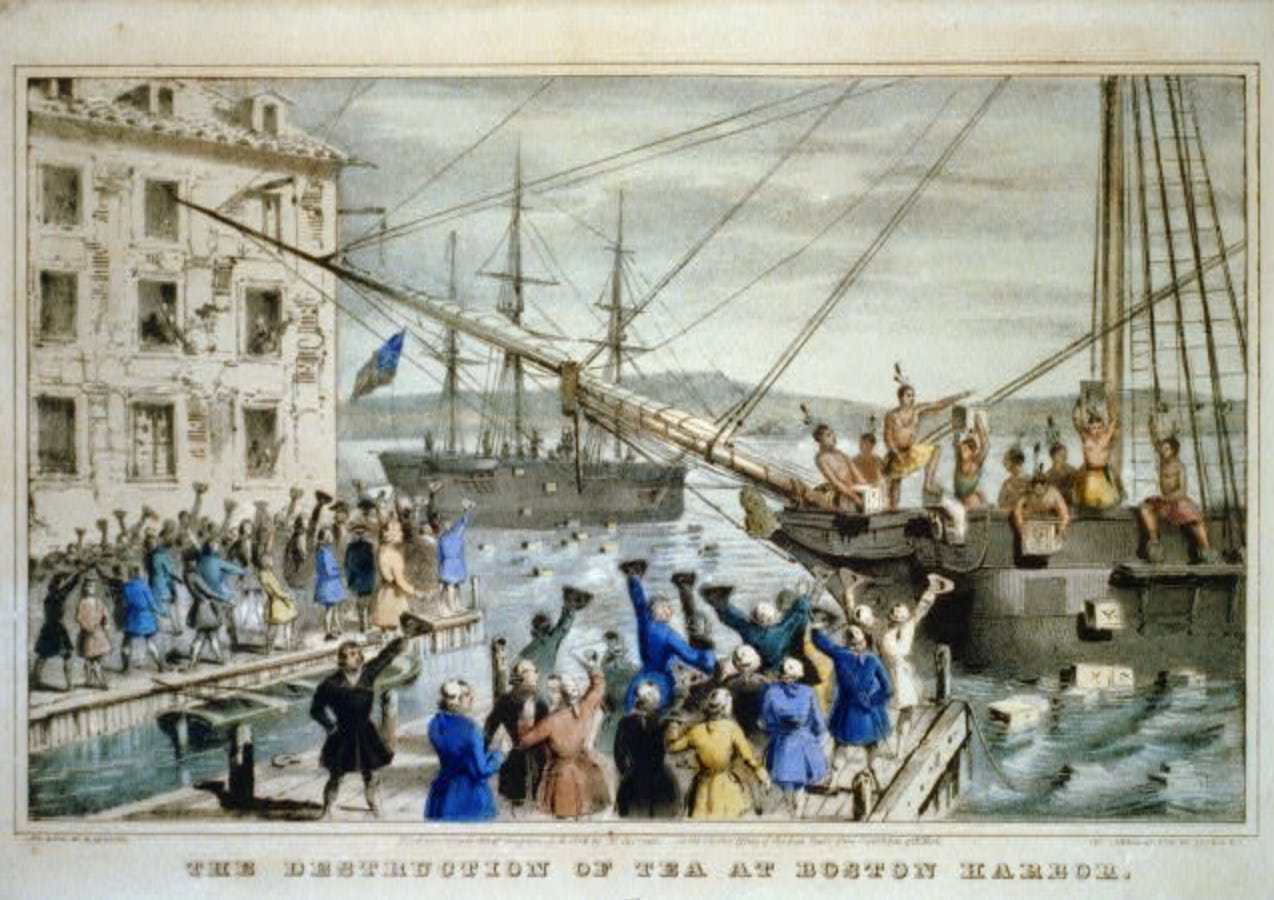
December 16, 1773: the Sons of Liberty, some disguised as Mohawks, dump the East India Company's tea into Boston Harbour.
The colonists read the deal differently. They saw a distant government handing a favoured monopoly direct access to their market while attaching a small tax whose only purpose was to establish that American consent was not required. The low price was not a gift. It was bait. Accept the cheap tea, and you accepted that the terms of your economic life would be written in a room where you held no seat.
So they refused delivery. New York and Philadelphia turned the ships around. Charleston let the tea rot on the docks. In Boston, after the governor refused to send the ships home, colonists boarded them and dumped 92,000 pounds of tea into the harbour.
Parliament answered with the Coercive Acts, and the road to July 4, 1776 was set.
What was the true cost of tea in America?
Americans in the early 1770s drank around two thirds of a pound of tea per person per year, at roughly three shillings a pound. The disputed tax came to two pennies per person per year.
Pause on that. The most famous consumer revolt in history was staged against a price cut. Why? Because Americans in 1773 understood something crucial: the listed price of an unnegotiated product is not its full and true cost.
The terms of the deal matter more.
What the colonists did next was negotiate on behalf of their future selves. The tea in front of them was cheap, but the precedent it set was expensive. They decided their collective future outweighed the discount and refused the deal.
That skill, negotiating your future interests at the moment of purchase, has been unlearned by modern consumers. Today, American citizens celebrate the glorious imagery of their forefathers’ rebellion. But in practice most people now live under what the founders fought to end: a system of terms written by their corporate suppliers under the guise of cheap products.
Cheap products, everywhere
The rebellion severed the deal with Britain, but it did not extinguish the problem. Global corporations like the East India Company continued writing one-sided terms without buyer input. In fact, global corporations have since perfected their ability to write terms that pass on hidden costs to their buyers.
Sugar was the biggest global commodity in 1776. Its price was kept low by slavery, the largest hidden cost in history. The freedom-seeking Americans who took sugar with their tea financed slavery, even those who advocated against it.
Today, energy is the largest example. Gasoline and grid power are spectacularly cheap for what they do, but the cost of carbon remains unpriced, and the deferred bill is now arriving in the form of rising insurance premiums for fires and floods and rising taxes for disaster recovery. The International Monetary Fund puts the cost at nearly $7 trillion a year in unpriced damage from fossil fuel products.
Free social media is the purest case of terms that pass on hidden costs to their buyers. The discount went to zero, while the terms took your data, your attention, and permission to run experiments on your children's minds. Lord North would have wept at the elegance of it.
Ultra-cheap calories run the same scheme. Processed foods are engineered to be irresistible and cheap per portion. The deferred bill is part of the reason America's health care now costs $5.3 trillion a year.
In every case, the supplier negotiated for its own future interests and Americans did not. None of us did.
The Declaration of Independence: a master agreement
Two and a half years after the tea went into the harbour, the same Americans who had refused the deal sat down to write a master agreement. They gave it a name: the Declaration of Independence. It is not a poem about liberty. At its core, the Declaration of Independence is a terms-and-conditions document, and it follows the anatomy of one almost clause for clause. It opens by establishing that governments derive "their just Powers from the Consent of the Governed," and when a government becomes destructive of these ends, the people may alter or abolish it. It proceeds by itemizing twenty-seven breaches by the King, and even documents the notice given: "Our repeated Petitions have been answered only by repeated injury." And it closes with the remedy every contract reserves for material breach: Termination.
The theme that dominates July 4th is that America was founded on the hope of freedom and the pursuit of happiness. But its foundation is a universal principle of equality, based on a self-evident truth.
Freedom cannot exist without the right to negotiate for your future interests.
In 1776, Americans made it clear that a discount on tea is not a deal if its hidden terms undermine the future of citizenship.
That idea never expired. Modern commerce, and the politics it funds, runs on terms most people on earth never wrote and cannot see. None of this is new. The marriage of corporate supplier terms and global politics is as old as the bailout of the East India Company in 1773. The Declaration of Independence, and the founding of America itself, came out of a fight against hidden costs buried in the terms of a bad deal. That fight was never finished.
Ensuring that hidden costs are negotiated out of your life — and the economy — is the mission of Supplierism. Unpriced environmental damage, extracted data and engineered attention, political corruption, exploited supply-chain labour, AI’s displacement of work, the mental health of children. These are just some of the hidden costs attached to things we purchase every day.
Healthy citizenship requires that we manage our suppliers with enforceable agreements. That is why Supplierism is making the tools for writing terms and conditions available to everyone, for free.
No rebellion required.
Next week: Why Supplierism invents nothing. Every mechanism it relies on already exists, is already legal, and already works. The only new thing is who gets to use it.