

As a child, Robert Blincoe began his days before the sun, roused in the dark and marched to the cotton mill at five in the morning, where he worked until nine at night, six days a week. By the time he was sixteen, he had already worked close to forty thousand hours. Robert was a mule scavenger, crawling beneath the machines to gather up the loose fluff that fell on the floor. The cotton he helped produce went to Nottingham, where it was turned into stockings, lace and cloth, then sold to buyers across Europe and the Americas.
Sarah Gooder was eight years old when she worked in a coal pit, sitting alone in the dark for twelve hours opening and shutting a ventilation door.
“I’m a trapper in the Gawber pit,” she told a government investigator. “It does not tire me, but I have to trap without a light and I’m scared. I go at four and sometimes half past three in the morning, and come out at five and half past. Sometimes I sing when I’ve light, but not in the dark; I dare not sing then. I don’t like being in the pit.”
Patience Kershaw also worked in a coal mine. By seventeen she had spent a decade underground. She dragged wooden carts along the low tunnels for a mile or more to the shaft and back again.
“I never went to day-school. I go to Sunday-school, but I cannot read or write. The bald place upon my head is made by thrusting the corves. Sometimes they beat me, if I am not quick enough, with their hands. I would rather work in mill than in coal-pit.”
Elizabeth Bentley began working in a flax mill at six years old, pulling the full bobbins off the spinning frames and pushing empty ones on, so the machines never stopped. In the busy season she did it from five in the morning until nine at night, sixteen hours, with forty minutes to eat.
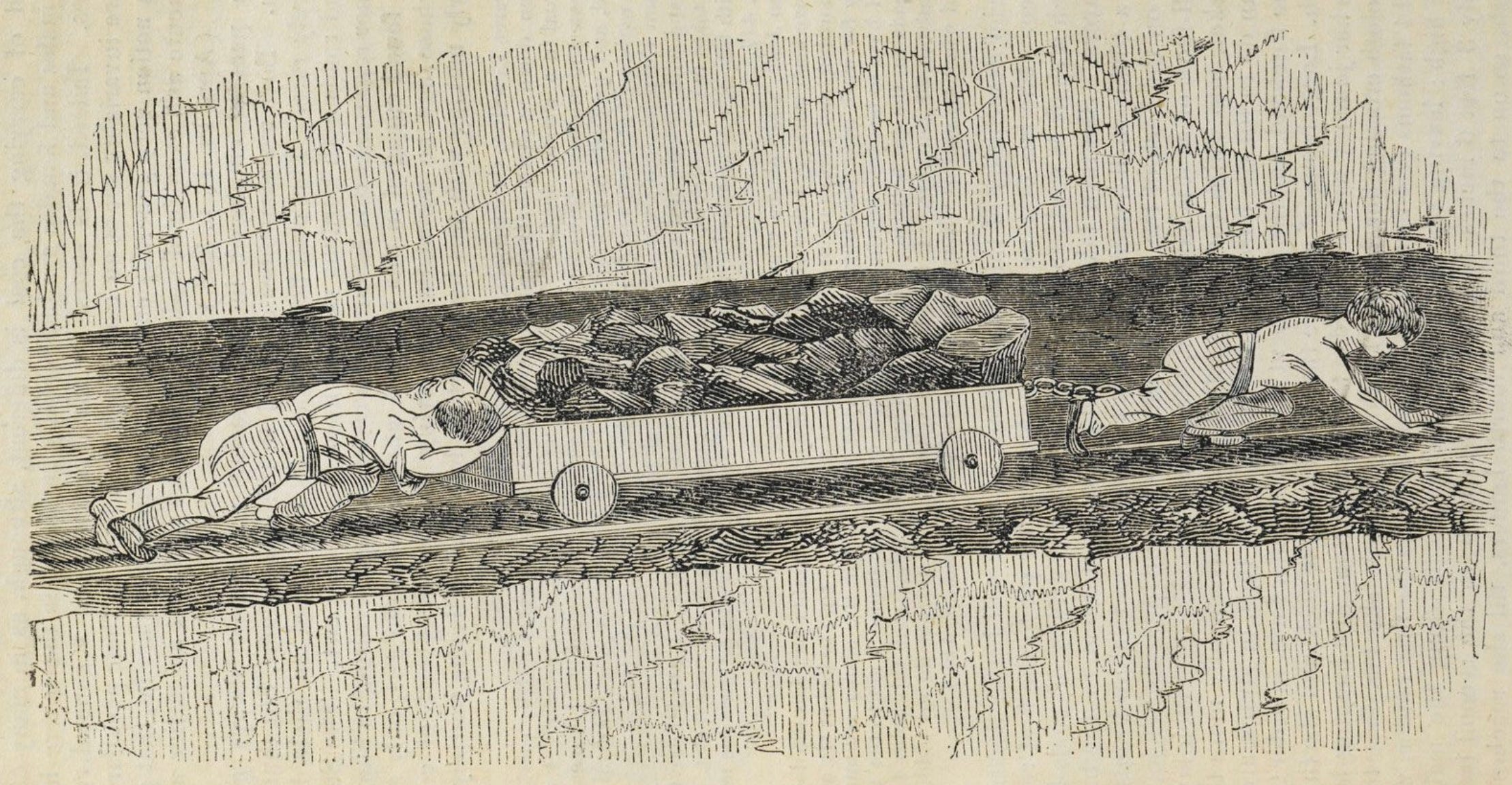
Reports of these horrors prompted the government to act. The first child labour law passed in 1802, and others followed, but with no one to enforce them, each was simply ignored. A pattern repeated itself for decades: a commission would take the children’s testimony and reforming MPs would introduce a bill. The manufacturers would then fight it, claiming that protecting children would make British goods uncompetitive.
It took until 1918 — one hundred and sixteen years — to finally get children out of the factories.
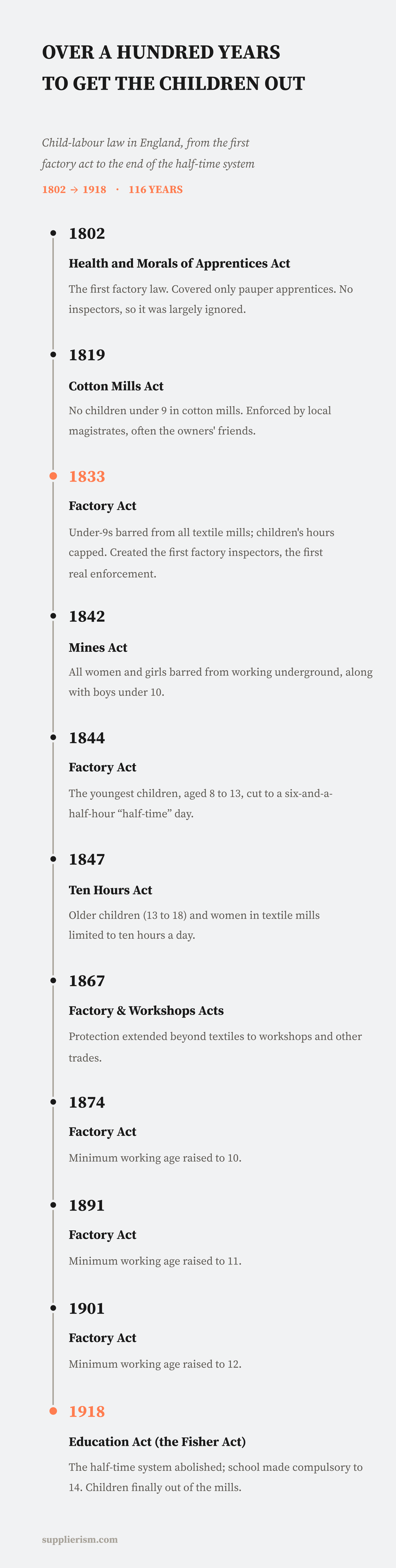
None of this is really that long ago. The clothes my grandparents wore as children were made by other children, in conditions that violated everything they believed in. I don’t reflect on that to somehow imbue the past with a capability it never had. Rather, the point is to inspire new thinking.
So here is a new perspective on the child abuse that lingered in England for over a century: English contract law gave buyers everything they needed to refuse child-made goods. Then, as now, the courts held that two parties could agree to the terms they chose, and a judge’s task was to enforce the agreement. A buyer who contracted with a supplier could have written a ban on child labour into the agreement, and could have sued if it was broken.
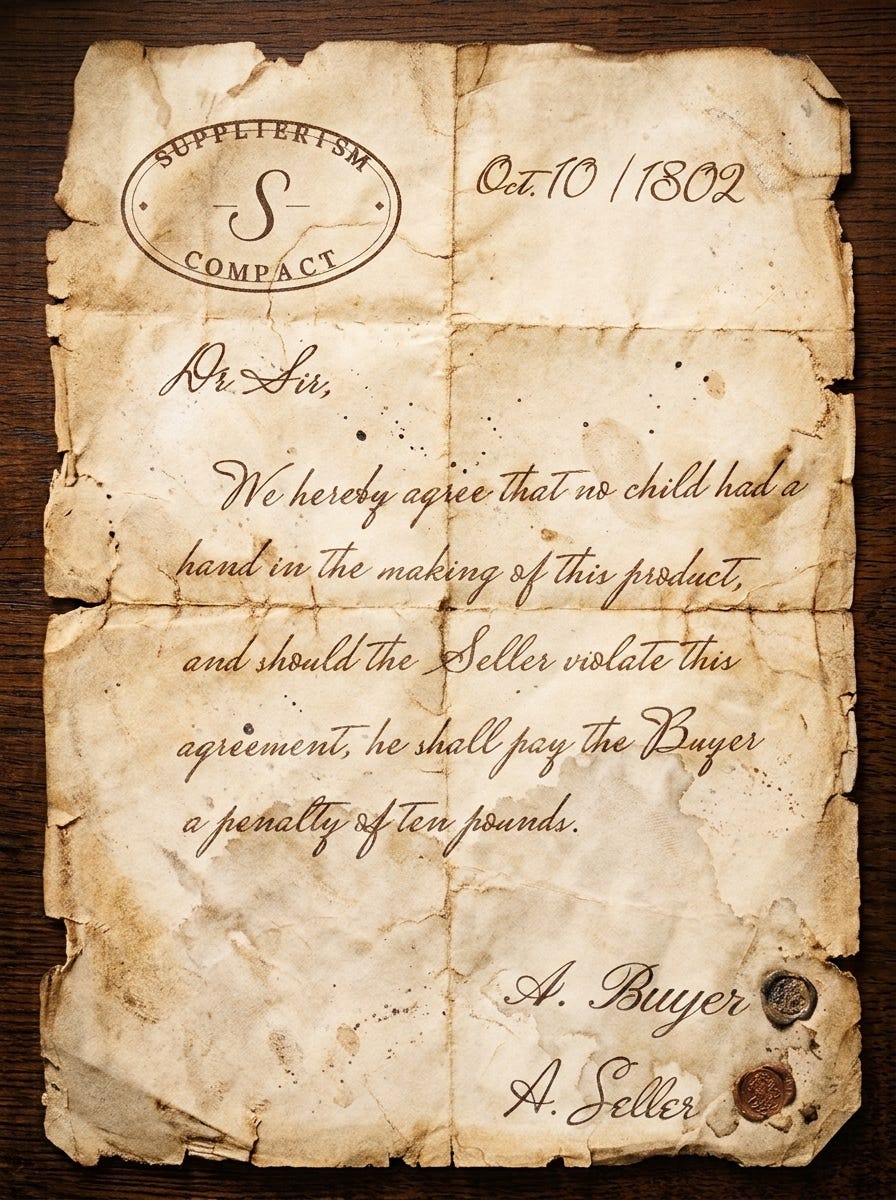
The power to stop child abuse was there the whole time, in plain view. But culture and psychology are stubbornly attached to the idea that regular people are powerless. A theory of social change almost always assumes that governments must step in to manage our suppliers for us. History tells a different story. In reality, governments tend to produce slow, watered-down, and ineffective laws.
Here are nine global supplier problems that governments have tried and failed to regulate:
Carbon emissions
Forever chemicals
Conflict minerals
Antibiotics in livestock
Electronic waste
Plastic pollution
Data harvesting and privacy
Social media harm
Corporate corruption
In every case, the contract law to end the problem already exists. Buyers need only use the powers they have always had to set the terms their suppliers must meet.
The right to set terms is old. The only new part is deciding, together, to use it.